
Stenus colon
Say, 1831
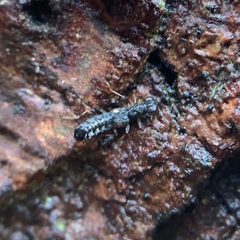
Stenus colon is a of rove beetle in the Staphylinidae, commonly referred to as a water skater due to its association with moist . It was described by Thomas Say in 1831 and occurs across eastern and central North America. The species belongs to the large Stenus, which contains over 3,000 described species worldwide, many of which are semi-aquatic or inhabit wet environments.
Pronunciation
How to pronounce Stenus colon: /ˈste.nus ˈko.lɔn/
These audio files are automatically generated. While they are not always 100% accurate, they are a good starting point.
Images
Habitat
Associated with moist or wet environments, consistent with the semi-aquatic habits typical of many Stenus .
Distribution
North America: Canada (Ontario) and United States (Connecticut, District of Columbia, Florida, Georgia, Iowa, Illinois, Indiana, Kansas, Kentucky, Louisiana, Massachusetts, Michigan, Missouri, Mississippi, North Carolina, Nebraska, New Hampshire, New Jersey, New York, Ohio, Pennsylvania, South Carolina, Tennessee, Texas, Virginia, Wisconsin, West Virginia).
More Details
Taxonomic note
Catalogue of Life lists Stenus colon as a synonym, though GBIF and iNaturalist treat it as an accepted . The taxonomic status may require verification.
Genus characteristics
Members of Stenus possess pygidial glands that eject secretions for defense and, in some , for capturing prey. Many species in this are known for their ability to skate on water surfaces using these secretions to reduce surface tension.
Sources and further reading
- BugGuide
- Wikipedia
- GBIF taxonomy match
- iNaturalist taxon
- Catalogue of Life
- In the News: Hammock and Zhang Labs Target Obesity-Enhanced Colon Cancer | Bug Squad
- Why Timing Is Everything in Bumble Bee Colonies | Bug Squad
- Architectural Structure of Collapsed Feral Bee Colony Saved for UC Davis Public Display | Bug Squad
- A Termite-Control Twofer: How Baiting One Colony of Formosan Subterranean Termites Can Knock Out the Colony Next Door
- Short Bait Exposure Controls Asian Subterranean Termite Colonies
- Colony Size Drives Honey Bees' Overwinter Survival