
Dianous
Leach, 1819
Species Guides
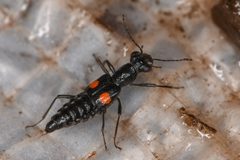
1Dianous is a of rove beetles in the Steninae, characterized by their specialized ability to glide across water surfaces. All representatives of this genus possess pygidial glands that secrete alkaloid and terpene compounds, including stenusine and related molecules, which reduce water surface tension to enable rapid skimming locomotion. The genus has been documented across Europe, Asia, and North America, with particular taxonomic attention in China and Turkey where multiple new have been described in recent years. Dianous species are of small .
Pronunciation
How to pronounce Dianous: /ˈdi.a.nus/
These audio files are automatically generated. While they are not always 100% accurate, they are a good starting point.
Identification
Members of Dianous can be distinguished from the closely related Stenus by their consistent and highly developed water-gliding ability; while some Stenus exhibit this trait partially or not at all, all Dianous species are expert water gliders. Within Steninae, Dianous species are recognized by their pygidial gland secretion chemistry, which includes piperidine and pyridine-derived alkaloids (stenusine, norstenusine) alongside terpenes such as α-pinene and 1,8-cineole. Species-level identification requires examination of male genitalia and detailed morphometric characters.
Images
Habitat
Aquatic and semi-aquatic environments, particularly the margins of streams, rivers, and lakes where water surface skimming is feasible. In Turkey, have been recorded across elevation gradients in the Black Sea region with documented altitudinal variation. The Liupan Shan Natural Reserve in Ningxia, China, has yielded specimens from mountainous stream .
Distribution
Europe, Asia, and North America. In Asia, documented from Turkey (Eastern, Central, and Western Black Sea Regions), China (Zhejiang, Guangxi, Hubei, Ningxia, and other provinces), and Vietnam. European records include Denmark, Norway, and Sweden. Distribution records suggest a Palearctic range with extensions into Oriental regions.
Seasonality
In Turkey, phenological patterns indicate seasonal shifts in activity and elevation, with collection records spanning multiple months suggesting extended activity periods adjusted to local conditions.
Diet
of small , particularly Collembola (springtails) found in leaf litter and moist near water margins.
Behavior
Water surface skimming using pygidial gland secretions that dramatically reduce surface tension, enabling rapid and far-reaching locomotion even with minimal secretion emission. This represents an evolutionary distinct from the partial or absent skimming ability in related . Secretion compounds include stenusine, norstenusine, 3-(2-methyl-1-butenyl)pyridine, cicindeloine, α-pinene, 1,8-cineole, and 6-methyl-5-heptene-2-one. The beetles exhibit secretion-saving mechanisms during skimming.
Similar Taxa
- StenusConvergent water-gliding ability in some , but Stenus exhibits only partial or absent skimming capability compared to the universal expert gliding of Dianous; additionally, Stenus species possess the distinctive labial hunting apparatus (ejectable paraglossae with adhesive secretion) that Dianous lacks.
More Details
Chemical ecology
The pygidial gland secretion of Dianous coerulescens has been chemically characterized, revealing a multifunctional blend of alkaloids and terpenes that serves both defensive and locomotory functions. This secretion system represents a key evolutionary innovation within Steninae.
Taxonomic activity
The has been subject to intensive recent taxonomic revision, particularly in China where multiple (ocellatus, aereus, bimaculatus, luteoguttatus, calceatus) have been redefined and new described from provinces including Zhejiang, Guangxi, Hubei, and Ningxia.
Sources and further reading
- BugGuide
- Wikipedia
- GBIF taxonomy match
- iNaturalist taxon
- NCBI Taxonomy
- Catalogue of Life
- Uncategorized | Blog - Part 41
- 4 new species of water-gliding rove beetles discovered in Ningxia, China | Blog
- Reassessment of Dianous ponticus Fagel, 1963 (Staphylinidae: Steninae) and the genus Dianous in Turkey: Taxonomic, ecological, and distributional insights
- The genus Dianous in Zhejiang, East China (Coleoptera, Staphylinidae)
- Skimming behaviour and spreading potential of Stenus species and Dianous coerulescens (Coleoptera: Staphylinidae)
- Notes on the Dianous aereus complex with description of a new species (Coleoptera, Staphylinidae)
- Notes on the Dianous luteoguttatus complex with description of a new species (Coleoptera: Staphylinidae)
- Notes on the Dianous bimaculatus complex with description of a new species from China (Coleoptera, Staphylinidae)
- Notes on the genus Dianous LEACH, 1819 with description of a new species from China (Coleoptera, Staphylinidae)
- Taxonomy of the genus Dianous (Coleoptera: Staphylinidae: Steninae) in China and zoogeographic patterns of its distribution