
Steninae
MacLeay, W. S., 1825
Water Skater Beetles
Genus Guides
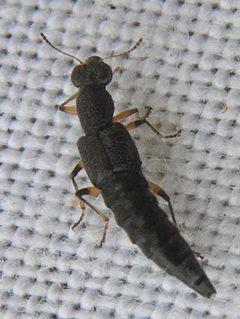
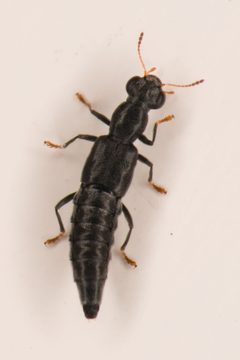
2Steninae is a megadiverse of rove beetles (Staphylinidae) containing over 3,000 worldwide, primarily in the *Stenus* and *Dianous*. Members are characterized by their unique prey-capture apparatus: a protrusible elongated with paraglossae modified into adhesive pads that eject via haemolymph pressure to capture springtails and other small arthropods. Many species exhibit remarkable water-gliding using gland secretions that reduce surface tension. are , visually oriented of moist .

Pronunciation
How to pronounce Steninae: //ˈstɛ.nɪˌniː//
These audio files are automatically generated. While they are not always 100% accurate, they are a good starting point.
Identification
Distinguished from other Staphylinidae by the combination of large , inserted between eyes on the vertex, and the unique protrusible labial prey-capture apparatus. *Stenus* generally possess the full water-gliding ability, while *Dianous* species are specialized water-gliders. Some *Stenus* species in terrestrial (e.g., leaf litter) lack this ability. The canaliculatus species group and other *Stenus* subgenera require examination of male genitalia for precise identification.
Images
Habitat
Moist microhabitats including waterside environments such as reeds, sparsely vegetated lake and river margins, and damp areas near streams. In tropical regions, also found in leaf litter and humus layers of forests. Terrestrial occupy leaf litter away from water.
Distribution
Worldwide distribution with over 3,000 . North America north of Mexico contains two : *Dianous* (2 species) and *Stenus* (167 species). Significant diversity in the Palaearctic region including Russia (Putorana Highland, Taymyr Peninsula, Siberia, Russian Far East), China (Ningxia, Tien Shan), and Turkey. Cretaceous fossils from Burmese amber document ancient lineage presence in Asia.
Seasonality
Activity patterns vary by and elevation. *Dianous ponticus* in Turkey shows seasonal shifts in activity correlated with elevation, suggesting phenological variation across its range. are .
Diet
of small , primarily Collembola (springtails) and other small arthropods found in leaf litter and moist .
Life Cycle
Developmental stages from to have been described, though specific timing varies by and environment.
Behavior
and optically oriented foraging. Prey capture involves ejection of the using blood pressure; the paraglossae adhere to prey via a glue-like substance exuded from pores between the bristly hairs, securing capture. More than 70 distinct behavioral patterns have been documented across functional categories including feeding, , , resting, and protection. Water-gliding in *Dianous* and some *Stenus* involves secretion of surface-tension-reducing compounds from pygidial glands, allowing rapid movement across water surfaces.
Ecological Role
regulating of springtails and other small soil arthropods. Defensive secretions containing alkaloids and terpenoids may influence microbial and deter predators, potentially affecting local dynamics.
Human Relevance
Subject of entomological research due to unique biomechanical adaptations (adhesive prey-capture apparatus, water-gliding). Some used as indicators for conservation assessment and quality monitoring. No significant economic impact documented.
Similar Taxa
- EuaesthetinaeSister to Steninae within Staphylinidae; distinguished by different antennal insertion and lack of protrusible adhesive
- ScydmaeninaeNext closest relative to Steninae + Euaesthetinae clade; lacks the specialized prey-capture apparatus of Steninae
- Other Staphylinidae subfamiliesDistinguished by the unique combination of large , vertexal antennal insertion, and protrusible labial prey-capture apparatus
More Details
Evolutionary History
Cretaceous Burmese amber inclusions (ca. 99 Ma) contain stem lineage Steninae (*Festenus* gen. nov.) with possible precursor to the *Stenus*-like prey-capture apparatus, indicating early origin of this key innovation that likely drove diversification of the crown *Stenus*.
Sources and further reading
- BugGuide
- Wikipedia
- iNaturalist taxon
- NCBI Taxonomy
- Catalogue of Life
- Uncategorized | Blog - Part 41
- From Forests to Cities: One Entomologist's Journey to Understand What's Disturbing Insects
- 4 new species of water-gliding rove beetles discovered in Ningxia, China | Blog
- The Biology of Steninae
- Checklist and distribution of the Steninae of America north of Mexico (Coleoptera, Staphylinidae) 374. Contribution to the knowledge of Steninae
- Reassessment of Dianous ponticus Fagel, 1963 (Staphylinidae: Steninae) and the genus Dianous in Turkey: Taxonomic, ecological, and distributional insights
- New species and records of Stenus (Nestus) of the canaliculatus group, with the erection of a new species group (Insecta: Coleoptera: Staphylinidae: Steninae)
- Cretaceous origin of the unique prey-capture apparatus in mega-diverse genus: stem lineage of Steninae rove beetles discovered in Burmese amber
- Taxonomy of the genus Dianous (Coleoptera: Staphylinidae: Steninae) in China and zoogeographic patterns of its distribution