
Stenus clavicornis
Gravenhorst, 1802
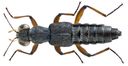
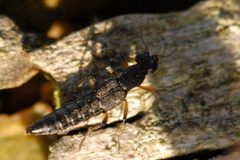
Stenus clavicornis is a of rove beetle in the Staphylinidae, Steninae. Like other members of the Stenus, this species possesses the ability to glide on water surfaces using specialized gland secretions that reduce surface tension. The species has been recorded across a broad Palearctic distribution and has been introduced to parts of North America.
Pronunciation
How to pronounce Stenus clavicornis: //ˈstiːnʊs klaviˈkɔrnɪs//
These audio files are automatically generated. While they are not always 100% accurate, they are a good starting point.
Images
Habitat
Associated with moist environments including shorelines and riparian where water-gliding can be utilized. Some Stenus occupy leaf litter habitats, though specific microhabitat preferences for S. clavicornis are not well documented.
Distribution
Native to Europe (recorded from 33 countries), Russia (European part, West and East Siberia, Far East), Georgia, Armenia, Azerbaijan, Turkey, Kazakhstan, Mongolia, Korea (North and South), Japan (Hokkaido), and China (Jilin, Heilongjiang, Xizang). Introduced to North America: Canada (British Columbia, New Brunswick, Nova Scotia, Ontario, Prince Edward Island, Quebec) and USA (Massachusetts, Maine, New Hampshire, Pennsylvania).
Diet
of small , particularly collembola (springtails), based on documented feeding habits of the Stenus.
Behavior
Capable of water-gliding using pygidial gland secretions that reduce water surface tension, allowing rapid movement across water surfaces. Members of the Stenus employ a distinctive prey capture mechanism: eversion of the using blood pressure to extend paraglossae coated with adhesive secretions that stick to prey.
Ecological Role
of small soil and litter-dwelling ; contributes to regulation of collembola in moist .
Similar Taxa
- Dianous speciesAlso in Steninae and capable of water-gliding, but Dianous are generally more specialized for this and have different body proportions.
- Other Stenus speciesMany Stenus share water-gliding ability and general body form; precise identification requires examination of genitalic and other subtle morphological characters.
More Details
Taxonomic note
The authorship of this is sometimes cited as Scopoli, 1763 in some databases, though Gravenhorst, 1802 is the accepted authority in major taxonomic works. The species has been placed in the subgenus Hypostenus by some authors.