
Stenus juno
(Paykull, 1789)
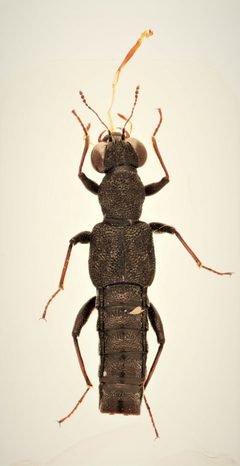
Stenus juno is a of predatory rove beetle in the Staphylinidae, Steninae. It was first described by Paykull in 1789. The species has a broad Holarctic distribution, occurring across Europe, northern Asia, and North America. Like other members of the Stenus, it possesses specialized adaptations for capturing prey.
Pronunciation
How to pronounce Stenus juno: /ˈstɛ.nəs ˈdʒuː.noʊ/
These audio files are automatically generated. While they are not always 100% accurate, they are a good starting point.
Identification
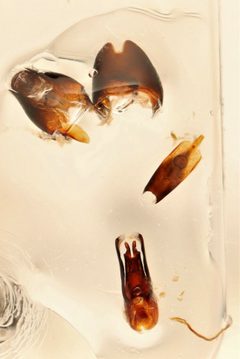
Stenus juno can be distinguished from other Stenus through examination of male genitalia and other subtle morphological features typical of the . Members of Stenus generally exhibit the characteristic rove beetle body plan with short exposing most of the . Accurate identification to species level typically requires reference to specialized taxonomic keys and examination by a .
Images
Habitat
Stenus juno has been recorded from a variety of across its broad range. Specific microhabitat preferences are not well documented in available sources, though Stenus are generally associated with moist environments near water bodies, leaf litter, and shoreline vegetation.
Distribution
Holarctic distribution: Europe (31 countries), Algeria, Russia (European part, Siberia, Far East), Iceland, Turkey, Georgia, Armenia, Azerbaijan, Kazakhstan, Japan (Hokkaido, Honshu), China (Heilongjiang, Ningxia, Shanxi), Canada (Alberta, British Columbia, Labrador, Manitoba, New Brunswick, Newfoundland, Nova Scotia, Northwest Territories, Ontario, Prince Edward Island, Quebec, Saskatchewan, Yukon), and the United States.
Diet
Predatory, feeding on small . Specific prey items for Stenus juno are not documented, though related Stenus are known to prey on collembolans and other small arthropods.
Behavior
Like other Stenus , Stenus juno likely possesses the -characteristic ability to glide on water surfaces using specialized pygidial gland secretions that reduce surface tension. Some Stenus species also employ a unique prey capture mechanism involving eversion of mouthparts using pressure, with adhesive secretions from paraglossae to secure prey.
Ecological Role
As a predatory , Stenus juno contributes to regulation of small in its . The is part of the diverse rove beetle fauna that plays important roles in decomposition and nutrient cycling in terrestrial and semi-aquatic .
Human Relevance
No direct human relevance has been documented. As a common but inconspicuous predatory , it contributes to natural of small pest in its .
Similar Taxa
- Stenus speciesOther members of the Stenus share similar body plans and ecological habits; accurate separation requires examination of subtle morphological characters and male genitalia.
- Dianous speciesRelated in Steninae with similar water-gliding adaptations and predatory habits; Dianous generally have more consistent water-gliding across all species.
More Details
Taxonomic history
Originally described as Staphylinus juno by Paykull in 1789, later transferred to the Stenus.
Subfamily characteristics
Steninae is a distinctive of Staphylinidae noted for unique chemical and morphological adaptations, including pygidial gland secretions that enable water surface locomotion in many .
Sources and further reading
- BugGuide
- Wikipedia
- GBIF taxonomy match
- iNaturalist taxon
- NCBI Taxonomy
- A 'Firecracker of a Surprise' in Davis: Who Knew? | Bug Squad
- A Close Call | Bug Squad
- What do insects do in winter? Migrants in the DMV: Common Buckeye, Junonia coenia, Variegated Fritillary, Euptoieta Claudia, Painted Lady, Vanessa cardui, Large Milkweed bug, Oncopeltus fasciatus — Bug of the Week
- Uncategorized | Blog - Part 41
- 🪲 Entomologizing w/ the WGNSS Entomology Group at Hughes Mountain Natural Area — 11 Oct 2025 | Beetles In The Bush