
Thinopinus pictus
LeConte, 1852
Pictured Rove Beetle
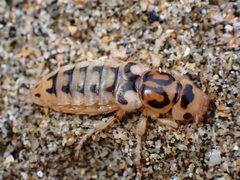
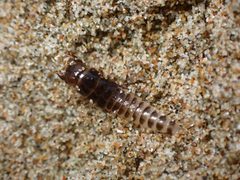
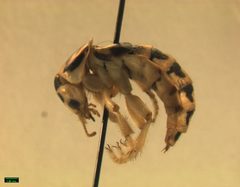
Thinopinus pictus is a wingless rove beetle (Coleoptera: Staphylinidae) to sandy beaches along the Pacific coast of North America from southern Alaska to Baja California. Both larvae and are strictly that emerge from temporary sand burrows at night to hunt beach hoppers (Orchestoidea). The exhibits limited and predictable patterns tied to tidal cycles, with forming a 15–30 meter wide band that shifts seaward during neap tides and landward during spring tides.
Pronunciation
How to pronounce Thinopinus pictus: /ˌθaɪnəˈpaɪnəs ˈpɪktəs/
These audio files are automatically generated. While they are not always 100% accurate, they are a good starting point.
Identification
Distinguished from other rove beetles by its exclusive association with sandy intertidal , activity pattern, and wingless condition. The combination of coastal beach habitat, at night from sand burrows, and on beach hoppers separates it from terrestrial Staphylinidae. Mark-recapture studies indicate low , with individuals showing high site fidelity and nearly identical emergence times on successive nights.
Images
Appearance
Wingless rove beetle with reduced or absent , exposing most of the . Body elongated and somewhat flattened, adapted for burrowing in sand. Coloration presumably provides camouflage against sandy substrates (specific color pattern details not documented in available sources).
Habitat
Strictly confined to intertidal sandy beaches along the Pacific coast. Occupies a narrow band 15–30 meters wide within the sandy beach zone, shifting position with tidal cycles. Requires soft, wet sand for burrowing; laboratory experiments demonstrate preference for substrates with higher permeability and moisture content. Creates temporary burrows in sand during daytime low tide periods.
Distribution
Pacific coast of North America from southern Alaska through British Columbia, Washington, Oregon, and California to Baja California, Mexico. Distribution records span approximately 3,000 km of continuous coastline.
Seasonality
Active year-round where climate permits; activity tied to low nighttime tides rather than seasonal cycles. occurs predictably at night when tides are low, with individuals remaining on the surface for only a few hours before returning to burrows.
Diet
; both larvae and feed primarily on beach hoppers (Orchestoidea), small crustaceans (amphipods) that inhabit the same sandy intertidal zone. Prey captured by waiting inactively on sand surface for passing beach hoppers.
Life Cycle
Complete with , larval, pupal, and stages. Both larval and adult stages are occupying the same . Specific details of egg deposition, larval development duration, and sites not documented in available sources.
Behavior
with highly stereotyped activity pattern. Emerges from temporary sand burrows at night during low tides to hunt, remaining inactive on the sand surface while waiting for prey. Shows strong site fidelity with low ; mark-recapture studies demonstrate individuals emerge at nearly identical times on successive nights. Burrows into sand during daytime or high tide periods. distribution shifts with tidal cycles: seaward during neap tides, landward during approaching spring tides, apparently tracking optimal moisture and sand permeability conditions.
Ecological Role
controlling of beach hoppers (Orchestoidea), a key consumer of beach wrack and primary decomposer in sandy intertidal . As a specialized intertidal predator, it contributes to trophic regulation within an ecosystem characterized by extreme physical stress and limited . Its presence indicates intact sandy beach with suitable moisture and permeability conditions.
Human Relevance
Subject of ecological research on intertidal dynamics and -prey relationships. No documented economic importance, pest status, or direct human uses. Its specialized requirements make it potentially vulnerable to beach habitat degradation.
Similar Taxa
- Other StaphylinidaeMost rove beetles are winged and occupy terrestrial or freshwater ; T. pictus is uniquely wingless and confined to intertidal sandy beaches.
- Other Thinopinus speciesThe contains few ; T. pictus is distinguished by its specific coastal distribution and association with beach hopper prey.
More Details
Tidal Tracking Behavior
Laboratory experiments with sand permeability and moisture gradients confirm that the ' preference for soft, wet sand explains its tidal tracking movements. This physiological preference allows to maintain optimal burrowing conditions as tide levels change.
Population Density
Observable at any moment is deceptively low (approximately 1 individual per several square meters) because many individuals remain buried. Actual density is several times higher, estimated at approximately 5 individuals per square meter.
Sources and further reading
- BugGuide
- GBIF taxonomy match
- iNaturalist taxon
- NCBI Taxonomy
- Catalogue of Life
- India’s relic forests reveal a new species of leopard gecko
- herpetofauna | Blog
- new species | Blog - Part 14
- biodiversity | Blog - Part 19
- Pensoft Editorial Team | Blog - Part 49
- reptiles | Blog - Part 2
- The Behavior and Distribution of the Intertidal Sand Beetle, Thinopinus Pictus (Coleoptera: Staphylinidae)