Philonthus discoideus
(Gravenhorst, 1802)
Disk-shaped Rove Beetle
Philonthus discoideus is a predatory rove beetle in the Staphylinidae, widespread across multiple continents including native Palearctic distribution and introduced ranges in the Americas, Australasia, and Pacific islands. The has been observed in carrion-associated and exhibits typical staphylinid with shortened exposing most of the . Its broad distribution suggests ecological adaptability, though specific behavioral and details remain poorly documented in published sources.
Pronunciation
How to pronounce Philonthus discoideus: //fɪˈlɒnθəs dɪˈskɔɪdiəs//
These audio files are automatically generated. While they are not always 100% accurate, they are a good starting point.
Identification
Distinguished from other rove beetles by combination of Philonthus characteristics (large , prominent , distinctive male genitalia) and -specific features implied by the epithet "discoideus." Accurate identification requires examination of aedeagal structures and comparison with or authoritative keys. The species may be confused with other medium-sized Philonthus species, particularly in regions where multiple occur sympatrically. Dissection and reference to original description (Gravenhorst, 1802) or modern taxonomic revisions is recommended for definitive identification.
Images
Appearance
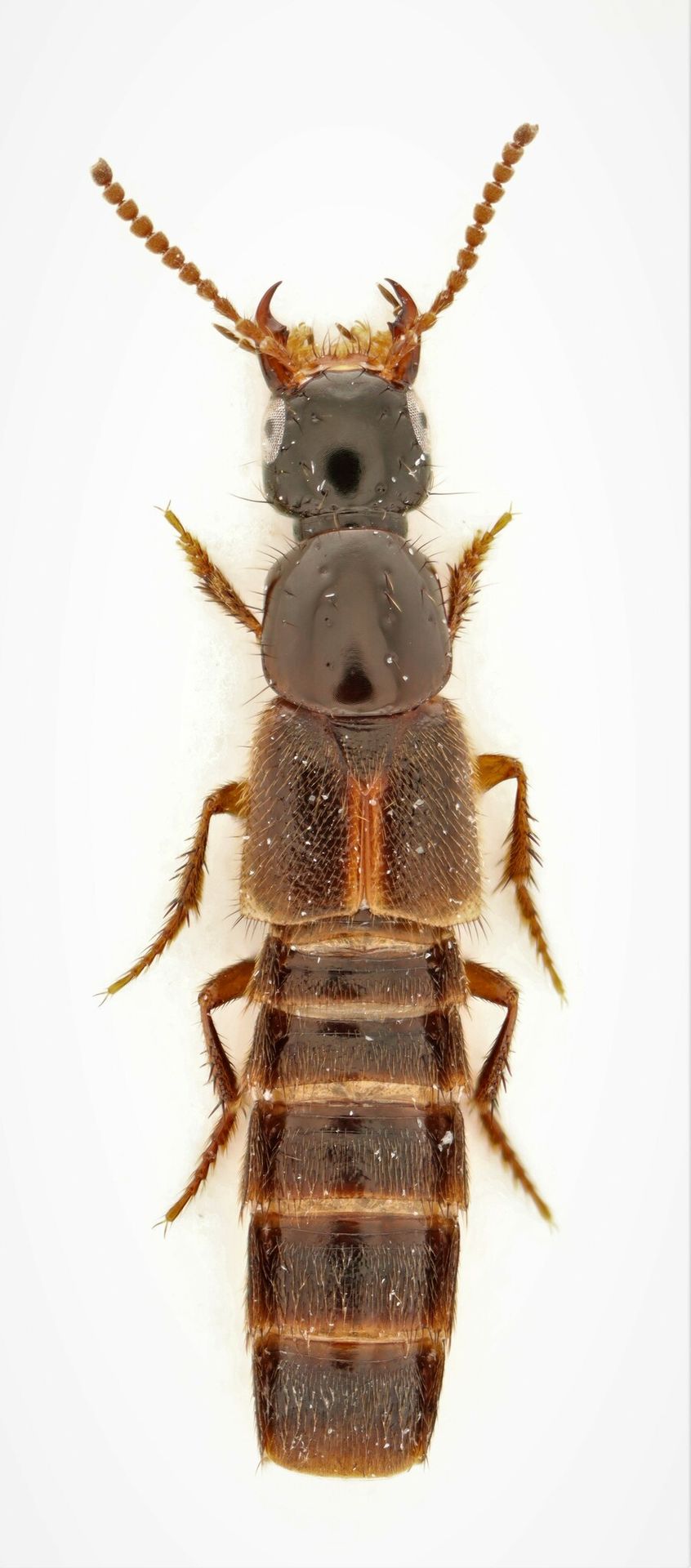
Medium-sized rove beetle with characteristic abbreviated leaving most abdominal segments exposed. Body form typical of Philonthus: elongate, somewhat flattened, with relatively long legs and . Coloration and specific markings not well documented in available sources. The specific epithet "discoideus" suggests a disc-shaped or rounded feature, possibly referring to abdominal or pronotal characteristics. , if present, has not been described in accessible literature.
Habitat
Observed in carrion and decomposition ; associated with vertebrate remains where it likely preys on fly larvae and other carrion inhabitants. The has been recorded from varied environments across its extensive range, suggesting adaptability to multiple habitat types including open landscapes, woodlands, and human-modified environments. Specific microhabitat preferences remain poorly characterized.
Distribution
Native to Palearctic region: Europe, North Africa, Iran, Korea, and Japan. Introduced and established in: North America (Canada, USA), Mexico through Colombia, Venezuela, Brazil, Argentina, Chile; Caribbean (Cuba, Jamaica, Hispaniola, Puerto Rico, Lesser Antilles); Australasia (Australia, New Zealand, Fiji, Tahiti, Hawaii); Pacific (Galápagos Islands); and western Indian Ocean (Madagascar, Mauritius, Réunion). Records from Atlantic islands (Azores: São Miguel, Santa Maria, Terceira).
Seasonality
activity patterns not well documented; likely active during warmer months in temperate regions with potential year-round activity in subtropical and tropical portions of its range. Specific phenological data are lacking in available sources.
Diet
Predatory, feeding on other insects and associated with carrion and decomposing organic matter. Has been observed in carrion beetle where it likely preys on dipteran larvae and other carrion inhabitants.
Life Cycle
Complete with , larval, pupal, and stages. Specific details of developmental duration, oviposition sites, and larval are not documented in available sources. Larvae likely inhabit same decomposition microhabitats as adults.
Behavior
and agile, typical of predatory staphylinids. likely active both day and night. When disturbed, exhibits rapid escape movements and may seek concealment in substrate. Capable of . Specific behavioral repertoires (mating, territoriality, ) have not been described in accessible literature.
Ecological Role
in carrion and decomposition , contributing to regulation of fly and nutrient cycling through decomposition systems. May serve as prey for larger and vertebrates. Role in processes outside carrion is poorly characterized.
Human Relevance
Potential utility in given its carrion association and widespread distribution, though specific case documentation is lacking. No known economic importance as pest or beneficial in agriculture. Presence in human-modified environments suggests of anthropogenic disturbance.
Similar Taxa
- Philonthus politusAnother medium-sized Philonthus associated with carrion; distinguished by subtle morphological differences requiring detailed examination
- Creophilus maxillosusLarger hairy rove beetle sharing carrion ; distinguished by larger size, distinctively hairy body, and more robust build
- Philonthus caeruleipennisSimilar-sized rove beetle with metallic blue-green coloration; distinguished by coloration and structural features
More Details
Taxonomic History
Originally described by Gravenhorst in 1802, this has undergone subsequent taxonomic revisions within the large and complex Philonthus. The broad distribution, particularly the extensive introduced range, suggests human-mediated over centuries, though specific introduction are not documented.
Conservation Status
Not evaluated by IUCN; the appears secure given its widespread distribution and adaptability.