
Myrmoecia
Mulsant & Rey, 1873
Species Guides
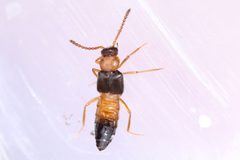
1Myrmoecia is a of rove beetles (Staphylinidae) in the tribe Lomechusini, Aleocharinae. The genus contains nine described distributed across the Holarctic region. Members of this genus are myrmecophilous, meaning they live in association with ants. The genus was established by Mulsant and Rey in 1873.
Identification
Myrmoecia can be distinguished from other Lomechusini by a combination of characters including the structure of the and the shape of the pronotum. The is characterized by compact body form and relatively short typical of aleocharine rove beetles. Specific identification to species level requires examination of genitalic structures and other fine morphological details.
Images
Habitat
in this are found in nests, where they live as myrmecophiles. They inhabit the nest structures of their ant colonies, typically in soil or decaying wood.
Distribution
The has a Holarctic distribution. have been recorded from North America (including Canada and the United States) and the Palearctic region (including Europe). Specific distribution varies by species: M. canadensis is known from Canada, while M. confragosa, M. physogaster, M. plicata, M. rigida, M. triangulum, and M. tuberiventris have Palearctic distributions.
Host Associations
- Formicidae - myrmecophileMyrmoecia live within colonies as social or commensals; specific ant have not been documented in the available sources
Behavior
Myrmoecia are myrmecophilous, living within colonies. The nature of their relationship with ants—whether parasitic, predatory, or commensal—has not been definitively characterized in published literature.
Ecological Role
As myrmecophiles, these beetles participate in the complex of organisms associated with colonies. Their exact ecological function within ant nests remains undocumented.
Similar Taxa
- LomechusaAlso in tribe Lomechusini and myrmecophilous; Myrmoecia differs in body proportions and tarsal structure
- MyrmecophilusDifferent (Staphylinidae: Tachyporinae or other ); Myrmoecia is distinguished by aleocharine characteristics including reduced tarsal formula
More Details
Taxonomic history
Myrmoecia was described by Mulsant and Rey in 1873. The has undergone taxonomic revision, with transferred in and out based on morphological studies. Maruyama and Klimaszewski (2006) described M. canadensis, the only North American species known from Canada.
Species diversity
Nine are currently recognized: M. canadensis, M. confragosa, M. lauta, M. lugubris, M. physogaster, M. plicata, M. rigida, M. triangulum, and M. tuberiventris. Several species were originally described in other and later transferred to Myrmoecia.