
Dinaraea
Thomson, 1858
Species Guides
3- Dinaraea aequata
- Dinaraea angustula(Rove beetle)
- Dinaraea bicornis
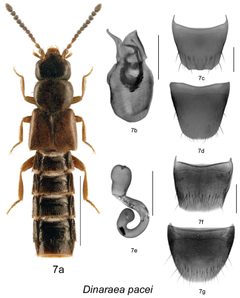
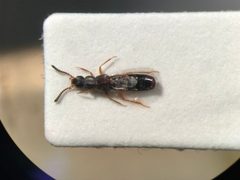
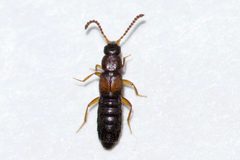
Dinaraea is a of rove beetles in the Staphylinidae, tribe Athetini, comprising approximately 16 described . The genus is saproxylic, inhabiting dead wood including subcortical galleries, rotting tree trunks, and polypore fruiting bodies. Larval was first described in 2018 based on two European species, revealing diagnostic characters for the genus and distinct morphological differences between early (L1) and late (L2–3) larval instars.
Pronunciation
How to pronounce Dinaraea: //ˌdɪnəˈriːə//
These audio files are automatically generated. While they are not always 100% accurate, they are a good starting point.
Identification
Diagnostic larval characters include specific chaetotaxy patterns distinguishing the from related aleocharine tribes. First instar larvae (L1) differ from later instars (L2–3) in lacking some setae on the surface of the , , and abdominal tergites and sternites; possessing a subapical seta on the urogomphi; bearing bursters on some thoracic and abdominal tergites; having darker pigmentation on antennal segment III; and exhibiting relatively longer urogomphi with longer setae. Inter-specific differences among mature larvae involve body colouration, degree of flattening, antennal structure, margin of the , , and mala.
Images
Habitat
Saproxylic; inhabits subcortical galleries created by other insects, rotting tree trunks, and fruiting bodies of polypore fungi. Specific microhabitats include birch bark remains in shady, damp deciduous woodland gullies and bark of wind-thrown ash in old riparian woodlands.
Distribution
Europe; documented from southeastern Poland (Parchatka near Kazimierz Dolny; Łańcuchów near Lublin). GBIF records indicate presence in Denmark, Norway, and Sweden. Five European are recognized: D. aequata, D. angustula, D. arcana, D. hungarica, and D. linearis.
Diet
Larvae have been observed to feed on small springtails (Onychiuridae) in laboratory rearing. diet is unknown.
Life Cycle
Holometabolous development with three larval instars (L1, L2–3), prepupal stage, and pupal stage within a pupal cocoon. First instar (L1) is morphologically distinct from later instars. Rearing completed at approximately 20°C over 2–3 months (November to January/February).
Behavior
Saproxylic lifestyle; inhabits subcortical spaces created by other insects.
Ecological Role
Potentially important as of economically significant forest pests, inferred from environmental preferences and probable predatory mode of life.
Sources and further reading
- BugGuide
- Wikipedia
- GBIF taxonomy match
- iNaturalist taxon
- NCBI Taxonomy
- Catalogue of Life
- First description of the larva of Dinaraea Thomson, 1858, with comments on chaetotaxy, pupa, and life history based on two saproxylic species from Europe (Staphylinidae, Aleocharinae, Athetini)
- Figures 1-11 from: Staniec B, Pietrykowska-Tudruj E, Pawlęga K (2018) First description of the larva of Dinaraea Thomson, 1858, with comments on chaetotaxy, pupa, and life history based on two saproxylic species from Europe (Staphylinidae, Aleocharinae, Athetini). ZooKeys 752: 99-123. https://doi.org/10.3897/zookeys.752.24440
- Figures 49-53 from: Staniec B, Pietrykowska-Tudruj E, Pawlęga K (2018) First description of the larva of Dinaraea Thomson, 1858, with comments on chaetotaxy, pupa, and life history based on two saproxylic species from Europe (Staphylinidae, Aleocharinae, Athetini). ZooKeys 752: 99-123. https://doi.org/10.3897/zookeys.752.24440
- Figures 24-32 from: Staniec B, Pietrykowska-Tudruj E, Pawlęga K (2018) First description of the larva of Dinaraea Thomson, 1858, with comments on chaetotaxy, pupa, and life history based on two saproxylic species from Europe (Staphylinidae, Aleocharinae, Athetini). ZooKeys 752: 99-123. https://doi.org/10.3897/zookeys.752.24440
- Figures 33-40 from: Staniec B, Pietrykowska-Tudruj E, Pawlęga K (2018) First description of the larva of Dinaraea Thomson, 1858, with comments on chaetotaxy, pupa, and life history based on two saproxylic species from Europe (Staphylinidae, Aleocharinae, Athetini). ZooKeys 752: 99-123. https://doi.org/10.3897/zookeys.752.24440
- Figures 41-48 from: Staniec B, Pietrykowska-Tudruj E, Pawlęga K (2018) First description of the larva of Dinaraea Thomson, 1858, with comments on chaetotaxy, pupa, and life history based on two saproxylic species from Europe (Staphylinidae, Aleocharinae, Athetini). ZooKeys 752: 99-123. https://doi.org/10.3897/zookeys.752.24440
- Figures 54-68 from: Staniec B, Pietrykowska-Tudruj E, Pawlęga K (2018) First description of the larva of Dinaraea Thomson, 1858, with comments on chaetotaxy, pupa, and life history based on two saproxylic species from Europe (Staphylinidae, Aleocharinae, Athetini). ZooKeys 752: 99-123. https://doi.org/10.3897/zookeys.752.24440
- Figures 12-23 from: Staniec B, Pietrykowska-Tudruj E, Pawlęga K (2018) First description of the larva of Dinaraea Thomson, 1858, with comments on chaetotaxy, pupa, and life history based on two saproxylic species from Europe (Staphylinidae, Aleocharinae, Athetini). ZooKeys 752: 99-123. https://doi.org/10.3897/zookeys.752.24440