
Athetini
Casey, 1910
Tribe Guides
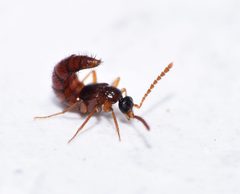
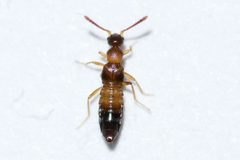
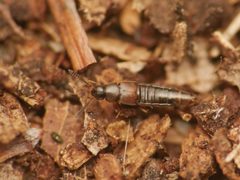
6Athetini is a large tribe of rove beetles (Staphylinidae: Aleocharinae) comprising at least 50 and 430 described . The tribe is taxonomically complex, with ongoing research into its limits and internal relationships; it was not recovered as monophyletic in molecular phylogenetic studies. Multiple independent origins of coastal specialization have been documented within the tribe.
Pronunciation
How to pronounce Athetini: /ˌæθəˈtaɪnaɪ/
These audio files are automatically generated. While they are not always 100% accurate, they are a good starting point.
Identification
Identification to tribe level requires examination of aleocharine characters including tarsal formula, mouthpart structure, and genital ; the tribe lacks consistent external synapomorphies and is currently defined by a combination of character states rather than single diagnostic features. Molecular phylogenetic studies have failed to recover Athetini as monophyletic, suggesting current tribal boundaries may not reflect evolutionary relationships.
Images
Habitat
are diverse across the tribe, ranging from terrestrial to coastal environments. At least five independent origins of coastal have been documented, involving such as Osakatheta, Adota, Pontomalota, Tarphiota, Thinusa, Iotarphia, and Psammostiba. Some occupy saproxylic (dead wood) habitats.
Distribution
Worldwide distribution with documented occurrences in the Western Palaearctic region (Europe, Canary Islands), North America, and East Asia (China, Taiwan).
Life Cycle
Larval development has been described for some ; in Dinaraea, three larval instars occur, with L1 differing from L2–3 in chaetotaxy, presence of bursters, and urogomphal proportions. Some Callicerus and Pseudosemiris are , with beginning in spring and preimaginal development completed by early summer.
Behavior
Ecological Role
Saproxylic contribute to decomposition of dead wood. Coastal species occupy intertidal and supralittoral zones, though their specific ecological functions in these remain poorly documented.
Similar Taxa
- TachyusiniClosely related tribe that together with Athetini, Ecitocharini, and Hygronomini forms a ; distinguished by different combinations of morphological characters and preferences.
- GeostibiniFormerly included Saphocallus, which was transferred to Geostibini based on phylogenetic analysis; Geostibini generally differ in genital and ecological associations.
More Details
Taxonomic complexity
Athetini is one of the most taxonomically challenging tribes in Aleocharinae. The former tribe Ecitocharini was synonymized with Athetini based on phylogenetic evidence. The Saphocallus was transferred to Geostibini. Ongoing molecular studies continue to reshape generic boundaries.
Molecular phylogeny
A concatenated dataset of mitochondrial (COI, COII, 16S rDNA, NADH1) and nuclear (18S rDNA, 28S rDNA) markers analyzed with , Bayesian, and maximum likelihood methods failed to support Athetini as monophyletic.
Sources and further reading
- BugGuide
- Wikipedia
- iNaturalist taxon
- NCBI Taxonomy
- Catalogue of Life
- Independent origins of coastal colonization in the tribe Athetini (Coleoptera, Staphylinidae)
- New species, synonymies, combinations, and records of micropterous Athetini from China (Coleoptera: Staphylinidae: Aleocharinae)
- On the Alevonota species of the Western Palaearctic region (Coleoptera: Staphylinidae: Aleocharinae: Athetini).
- A revision of Callicerus Gravenhorst, 1802, Pseudosemiris Machulka, 1935, and Saphocallus Sharp, 1888 (Coleoptera: Staphylinidae, Aleocharinae, Athetini).
- First description of the larva of Dinaraea Thomson, 1858, with comments on chaetotaxy, pupa, and life history based on two saproxylic species from Europe (Staphylinidae, Aleocharinae, Athetini)
- Species review of the genus Boreophilia Benick from North America (Coleoptera, Staphylinidae, Aleocharinae, Athetini): Systematics, habitat, and distribution
- Figures 2-5 from: Klimaszewski J, Sikes DS, Brunke A, Bourdon C (2019) Species review of the genus Boreophilia Benick from North America (Coleoptera, Staphylinidae, Aleocharinae, Athetini): Systematics, habitat, and distribution. ZooKeys 848: 57-102. https://doi.org/10.3897/zookeys.848.34846
- Figures 53-56 from: Klimaszewski J, Sikes DS, Brunke A, Bourdon C (2019) Species review of the genus Boreophilia Benick from North America (Coleoptera, Staphylinidae, Aleocharinae, Athetini): Systematics, habitat, and distribution. ZooKeys 848: 57-102. https://doi.org/10.3897/zookeys.848.34846
- Figures 117-120 from: Klimaszewski J, Sikes DS, Brunke A, Bourdon C (2019) Species review of the genus Boreophilia Benick from North America (Coleoptera, Staphylinidae, Aleocharinae, Athetini): Systematics, habitat, and distribution. ZooKeys 848: 57-102. https://doi.org/10.3897/zookeys.848.34846
- Figures 57-62 from: Klimaszewski J, Sikes DS, Brunke A, Bourdon C (2019) Species review of the genus Boreophilia Benick from North America (Coleoptera, Staphylinidae, Aleocharinae, Athetini): Systematics, habitat, and distribution. ZooKeys 848: 57-102. https://doi.org/10.3897/zookeys.848.34846
- Figures 109-116 from: Klimaszewski J, Sikes DS, Brunke A, Bourdon C (2019) Species review of the genus Boreophilia Benick from North America (Coleoptera, Staphylinidae, Aleocharinae, Athetini): Systematics, habitat, and distribution. ZooKeys 848: 57-102. https://doi.org/10.3897/zookeys.848.34846
- Figures 100-108 from: Klimaszewski J, Sikes DS, Brunke A, Bourdon C (2019) Species review of the genus Boreophilia Benick from North America (Coleoptera, Staphylinidae, Aleocharinae, Athetini): Systematics, habitat, and distribution. ZooKeys 848: 57-102. https://doi.org/10.3897/zookeys.848.34846
- Figures 24-31 from: Klimaszewski J, Sikes DS, Brunke A, Bourdon C (2019) Species review of the genus Boreophilia Benick from North America (Coleoptera, Staphylinidae, Aleocharinae, Athetini): Systematics, habitat, and distribution. ZooKeys 848: 57-102. https://doi.org/10.3897/zookeys.848.34846
- Figures 81-83 from: Klimaszewski J, Sikes DS, Brunke A, Bourdon C (2019) Species review of the genus Boreophilia Benick from North America (Coleoptera, Staphylinidae, Aleocharinae, Athetini): Systematics, habitat, and distribution. ZooKeys 848: 57-102. https://doi.org/10.3897/zookeys.848.34846