
Thanatophilus
Leach, 1815
carrion beetles, silky carrion beetles
Species Guides
5- Thanatophilus coloradensis
- Thanatophilus lapponicus(Northern Carrion Beetle)
- Thanatophilus sagax(Carrion Beetle)
- Thanatophilus trituberculatus(Cold-shore Carrion Beetle)
- Thanatophilus truncatus(Northern Carrion Beetle)
Thanatophilus is a of approximately 12 described of carrion beetles in the Silphidae. These beetles are primarily necrophagous, feeding on decaying animal matter. They occupy the Holarctic and Afrotropical realms and are frequently detected on large carrion, including human remains. Several species are forensically important for estimating time of and post-mortem intervals.


Pronunciation
How to pronounce Thanatophilus: /θænəˈtoʊfɪləs/
These audio files are automatically generated. While they are not always 100% accurate, they are a good starting point.
Identification
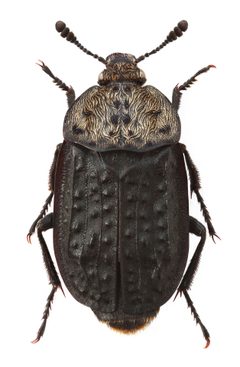
Thanatophilus are medium-sized carrion beetles, typically 8–15 mm in length. They superficially resemble dermestid beetles but belong to the Silphidae. The can be distinguished from the related burying beetles (Nicrophorus) by the absence of orange-red pronotal markings. Some species, such as Thanatophilus lapponicus, have notably hairy bodies.
Images
Habitat
Carrion; found on animal carcasses, bones, and decaying vertebrate remains. occupy diverse elevations from lowland zones (0–600 m) to mountainous regions. Thanatophilus sinuatus prefers open, sun-exposed with thermophilous vegetation.
Distribution
Holarctic and Afrotropical realms. Individual ranges include: Europe, Asia (Palaearctic), North America (northern tier of U.S., Alaska, Canada, Rocky Mountain states, Pacific states to Baja Mexico), Kazakhstan (Western Tien Shan Mts.), and Russia (Greater Caucasus Mts.).
Seasonality
active from early spring through autumn. Thanatophilus lapponicus recorded from March to October in North America. Thanatophilus rugosus active during early spring in central Europe and throughout most of the year in Southern Europe.
Diet
Necrophagous; feeds on carrion including decaying meat, animal carcasses, and dried remains. Laboratory studies confirm almost strictly necrophagous , though capable of limited on living larvae even when preferred food is present.
Life Cycle
Complete : , three larval instars, post-feeding stage, pupa, . Development temperature-dependent; from 25.66 days at 22°C to 88.36 days at 12°C in T. rugosus. Greatest developmental time proportion spent in post-feeding (24%) and pupal (33%) stages.
Behavior
Larvae exhibit cannibalistic ; third instar larvae observed feeding on second instar larvae, recognized by feeding marks on side with plate remnants. locate carrion using olfactory cues including dimethyldisulfide and butan-1-ol.
Ecological Role
Important necrophagous decomposers that accelerate carcass breakdown. Forensically valuable for estimating post-mortem intervals, particularly during cold seasons when other forensically important are absent. Contributes to nutrient cycling in terrestrial .
Human Relevance
: frequently detected on human remains and used to estimate time of and post-mortem interval. Research subjects for developmental and thermal summation models.
Similar Taxa
- NicrophorusAlso Silphidae, but distinguished by orange-red pronotal markings and burying ; Nicrophorus works in pairs to bury small carcasses while Thanatophilus does not.
- DermestesSuperficially similar hairy appearance and carrion association, but Dermestes belongs to Dermestidae and has different antennal structure and body shape.
Sources and further reading
- BugGuide
- Wikipedia
- GBIF taxonomy match
- iNaturalist taxon
- NCBI Taxonomy
- Catalogue of Life
- Bug Eric: Beetles from Bones
- Bug Eric: More Beetles from Bones
- Developmental models of the carrion beetle Thanatophilus rugosus (Linnaeus, 1758) (Coleoptera: Silphidae)
- SPATIAL DISTRIBUTION MODELING OF THANATOPHILUS SINUATUS (COLEOPTERA: SILPHIDAE) IN THE CZECH REPUBLIC
- Notes on distribution of Thanatophilus porrectus (A.P. Semenov, 1891) (Coleoptera: Staphylinidae: Silphinae)
- SEASONAL ACTIVITY AND SPATIAL DISTRIBUTION OF NECRODES LITTORALIS AND THANATOPHILUS RUGOSUS (COLEOPTERA: SILPHIDAE)
- In vitro comparison of two food choice methodologies for necrophagous species of the genus Thanatophilus (Coleoptera: Staphylinidae: Silphinae)
- The Impact of Diet and Photoperiodism on the Life History ofThanatophilus sinuatus(Coleoptera: Silphidae)
- Electrophysiological and Behavioral Responses ofThanatophilus sinuatusFabricius (Coleoptera: Silphidae) to Selected Cadaveric Volatile Organic Compounds
- A chromosomal-level genome assembly of Thanatophilus sinuatus Fabricius (Coleoptera: Staphylinidae).