
Necrodes
Leach, 1815
Species Guides
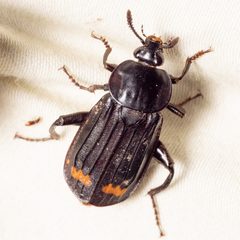
1- Necrodes surinamensis(Red-lined Carrion Beetle)
Necrodes is a of carrion beetles in the Silphidae (or Staphylinidae in some classifications), with at least four described . These beetles are decomposers of large vertebrate carrion in terrestrial , where they compete with blow flies through mixed competition involving both exploitative and interference effects. They exhibit high ability, with individuals documented traveling over 30 km, and form massive larval that generate heat through thermogenesis. The genus has significant forensic importance, particularly N. littoralis, which is used as a bio-indicator for estimating post-mortem intervals.
Pronunciation
How to pronounce Necrodes: //ˈnɛkroʊˌdiːz//
These audio files are automatically generated. While they are not always 100% accurate, they are a good starting point.
Identification
are distinguished from similar carrion beetles by their association with large vertebrate carrion in later decomposition stages, typically arriving around peak bloating. Larvae form massive on carrion and produce heat through collective activity. The is characterized by communal breeding with multiple conspecifics ovipositing on the same carcass.
Images
Habitat
Terrestrial , particularly forests (alder, hornbeam-oak, pine-oak, birch) and grasslands. Associated with large vertebrate carrion in outdoor environments including woodlands, bushes, and fields. Colonizes carcasses in advanced stages of decomposition, though also present in early decomposition stages.
Distribution
Palearctic region with records from Europe, including France and Central European countries (Poland, Denmark, Norway, Sweden). N. surinamensis occurs in the Neotropics (Suriname). Documented in temperate terrestrial ; some with Mediterranean influences.
Seasonality
active primarily in spring and summer, with approximately 73.5% of observations occurring during these seasons. Colonizes carrion later than blow flies, typically arriving around peak bloating of carcasses.
Diet
Necrophagous; feeds on soft tissues of large vertebrate carrion. N. littoralis has been observed killing and consuming blow fly larvae (Calliphoridae), preferentially targeting feeding-phase larvae (late second instar and early third instar) over post-feeding larvae.
Host Associations
- blow flies (Calliphoridae: Lucilia caesar, L. sericata, Calliphora vicina, C. vomitoria) - competitor/prey beetles kill fly larvae; negative relationship between fly and contribution to decay
- Chrysomya albiceps - co-occursFrequently associated in forensic cases
- Necrobia spp. - co-occursFound together on carrion in forensic studies
- Creophilus maxillosus - co-occursFrequently associated in forensic cases
- Fanniidae/Muscidae - co-occursAssociated dipterans in cases
- Sarcophaga spp. - co-occursAttracted to similar carrion volatile compounds in field studies
Life Cycle
Communal breeding with multiple conspecifics ovipositing on the same carcass. Larvae progress through three instars (L1, L2, L3) feeding on carrion soft tissues. Massive larval form on carrion, generating heat through collective activity and exodigestion. Development time shortens with increased larval due to positive thermogenic effects.
Behavior
Highly mobile with documented exceeding 30 km for individual N. littoralis; mean estimated dispersal distance of 6 km. locate carrion using olfactory cues, with probability increased when carrion is positioned up-wind. Exhibits voracious on blow fly larvae with selective killing —preferentially kills feeding larvae over post-feeding larvae. When competing with blow flies, adults reduce carrion preparation activity and engage in 'search and kill' behavior, which reduces thermogenesis in larval . Forms massive larval aggregations that elevate temperature in the feeding environment through collective metabolic activity.
Ecological Role
decomposer of large vertebrate carrion in terrestrial ; competes with blow flies through mixed competition (exploitative and interference effects). Drives nutrient transfer from carcasses to other ecosystem components. Thermogenic larval accelerate carrion decomposition. Forensically important used to estimate post-mortem intervals and detect post-mortem body manipulation.
Human Relevance
: N. littoralis observed in approximately 12.5% of French forensic cases (1990–2013), with strong association with outdoor death scenes. Developmental data valuable for estimating time of death. control implications: high ability (>30 km documented) suggests 3 km buffer strips around carcasses may be insufficient to prevent spread by these beetles. Laboratory rearing protocols established for forensic evidence preservation.
Similar Taxa
- ThanatophilusSimilar carrion beetle in Silphidae; both colonize vertebrate carrion and used in , though Necrodes arrives later in decomposition and exhibits stronger thermogenic larval
- blow flies (Calliphoridae)Primary competitors on carrion; blow flies colonize earlier and dominate fresh carrion, while Necrodes specializes in later stages and actively preys on fly larvae
More Details
Taxonomic placement note
Necrodes is variously placed in Silphidae (traditional classification) or as Silphinae within Staphylinidae (some modern classifications). The Catalogue of Life and recent literature place it in Staphylinidae: Silphinae.
Thermogenesis mechanism
Larval generate heat through collective exodigestion and metabolic activity; this thermogenesis is positively correlated with larval but negatively affected when engage in predatory against competitors rather than carrion preparation.
Competition dynamics
The interaction between Necrodes and blow flies represents mixed competition: indirect exploitative effects (resource consumption) combined with direct interference ( beetles killing fly larvae). Adult beetles kill feeding fly larvae 4 times more frequently than post-feeding larvae.
Sources and further reading
- BugGuide
- Wikipedia
- GBIF taxonomy match
- iNaturalist taxon
- NCBI Taxonomy
- Catalogue of Life
- SEASONAL ACTIVITY AND SPATIAL DISTRIBUTION OF NECRODES LITTORALIS AND THANATOPHILUS RUGOSUS (COLEOPTERA: SILPHIDAE)
- The biology and ecology of Necrodes littoralis, a species of forensic interest in Europe
- Competition of insect decomposers over large vertebrate carrion:Necrodesbeetles (Silphidae) vs. blow flies (Calliphoridae)
- Foraging on larval blow flies by adult carrion beetles Necrodes littoralis (Staphylinidae: Silphinae) reduces thermogenesis in the feeding matrix formed by the beetle larvae
- Response of adult carrion beetles Necrodes littoralis (L.) (Staphylinidae: Silphinae) to selected cadaveric volatile organic compounds: laboratory and field tests
- Competition, cooperation, and parental effects in larval aggregations formed on carrion by communally breeding beetles Necrodes littoralis (Staphylinidae: Silphinae)
- Estimating the Dispersal Ability of the Carrion Beetle Necrodes littoralis (Coleoptera: Staphylinidae: Silphinae) by Mark‐Recapture
- Guidelines for laboratory rearing of insect evidence: the importance of air humidity for breeding of Necrodes littoralis (L.) (Coleoptera: Staphylinidae).