
Aclypea opaca
(Linnaeus, 1758)
dark carrion beetle, beet carrion beetle
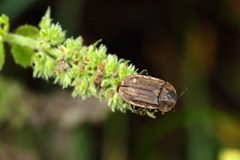
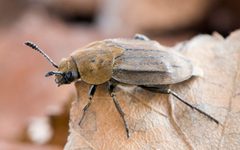
Aclypea opaca is a carrion beetle in the Silphidae, commonly known as the dark carrion beetle or beet carrion beetle. The is native to northern and central Europe and has been introduced to North America, where it occurs in Alaska and the Northwest Territories. Unlike many carrion beetles, species in the Aclypea are phytophagous, feeding on living plant material rather than carrion.
Pronunciation
How to pronounce Aclypea opaca: //əˈklaɪpiə oʊˈpɑːkə//
These audio files are automatically generated. While they are not always 100% accurate, they are a good starting point.
Identification
Aclypea opaca can be distinguished from other carrion beetles by the diagnostic cleft —a deep notch in the "upper lip" just behind the . It can be separated from the only other North American in the , A. bituberosa (Western Spinach Carrion Beetle), by geographic range: A. opaca is restricted to Alaska and the Northwest Territories, while A. bituberosa occurs from British Columbia and Washington east to Nebraska and Manitoba. A. bituberosa also possesses raised near the rear of each , which are absent in A. opaca.
Images
Distribution
Native to northern and central Europe; introduced to North America where it occurs in Alaska, the Northwest Territories, and the Yukon. The has also been recorded in the Azores as an introduction. In Europe, its range extends from Scandinavia southward, with records from Russia (European part, Siberia, Far East), Armenia, Georgia, Iran, Uzbekistan, Kyrgyzstan, Kazakhstan, and Mongolia. In China, it is known from Xinjiang and Xizang.
Diet
Phytophagous. and larvae feed on living plant material, including spinach, beets, wheat, radish, rhubarb, potato, lettuce, cabbage, turnip, rapeseed, pumpkin, squash, and lamb's quarters. Beets and spinach suffer the most damage in May.
Host Associations
- Spinacia oleracea - pestoccasional pest; one of the most damaged crops
- Beta vulgaris - pestsuffers the most damage in May
- Triticum aestivum - food plant
- Raphanus sativus - food plant
- Rheum rhabarbarum - food plant
- Solanum tuberosum - food plant
- Lactuca sativa - food plant
- Brassica oleracea - food plant
- Brassica rapa - food plant
- Brassica napus - food plant
- Cucurbita pepo - food plant
- Chenopodium album - food plantlamb's quarters, native
- Iva axillaris - food plantpovertyweed, native
Life Cycle
emerge early in spring. Females lay in soil, with larvae hatching in approximately one week. Larvae feed during the day on young leaves and shoots, hiding in soil at night. Three instars occur: the first two each last about five days, the third lasts approximately fifteen days. Mature larvae are black, 11–15 mm long. occurs 1–2 inches deep in soil, with adults emerging in about three weeks. One per year; adults overwinter.
Behavior
Larvae are feeders on above-ground plant parts, becoming nocturnally subterranean for shelter. are active from March through November.
Human Relevance
Considered an occasional agricultural pest, particularly of spinach and beets. Damage is most severe in May. The is not native to North America and was introduced accidentally.
Similar Taxa
- Aclypea bituberosaOnly other North American in ; distinguished by raised on and much broader geographic range (Pacific Northwest to Great Plains)
- Other SilphidaeMost carrion beetles are saprophagous on carrion; Aclypea are phytophagous, a notable ecological divergence within the
More Details
Taxonomic placement
Despite the "carrion beetle," in the Aclypea are unusual among Silphidae in being phytophagous rather than carrion-feeding. This represents a distinct ecological shift within the .
Introduction history
The appears to have been introduced accidentally to North America from Europe, with established in Alaska and the Northwest Territories. It is not known to have spread as extensively as some other introduced beetles.
Sources and further reading
- BugGuide
- Wikipedia
- GBIF taxonomy match
- iNaturalist taxon
- NCBI Taxonomy
- Catalogue of Life
- Bug Eric: Another Odd Carrion Beetle
- Psychidae | Beetles In The Bush
- The Holly and Ivy - A two part series: This week the holly and the native holly leaf miner, Phytomyza ilicicola — Bug of the Week
- Deck the halls with boughs of holly…and the Native holly leafminer, 'Phytomyza ilicicola', and Holly berry midge, 'Asphondylia ilicicola' — Bug of the Week
- Heliconiidae | Beetles In The Bush