
Aclypea
Reitter, 1884
Species Guides
2- Aclypea bituberosa(Western Spinach Carrion Beetle)
- Aclypea opaca(dark carrion beetle)
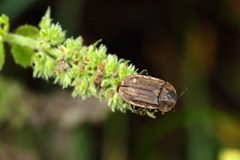
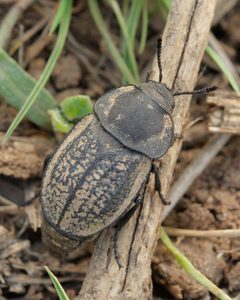
Aclypea is a of phytophagous carrion beetles in the Silphidae, to the Holarctic region. Unlike most carrion beetles, members of this genus are herbivorous rather than necrophagous. The genus contains approximately 11-13 described , with distributions spanning North America, Europe, and Asia. Species exhibit distinct preferences for steppe, semi-desert, and riparian environments.
Pronunciation
How to pronounce Aclypea: /æˈklaɪpiə/
These audio files are automatically generated. While they are not always 100% accurate, they are a good starting point.
Identification
The diagnostic character for Aclypea is a deeply cleft (upper lip) positioned just behind the , creating a distinctive notched appearance. Aclypea bituberosa can be further identified by paired raised near the of each and three conspicuous longitudinal ridges on each wing cover. Aclypea opaca lacks these tubercles and has a more restricted northern distribution. Aclypea kopetdaghica and A. calva are externally similar that require examination of male genitalia structure for definitive identification.
Images
Habitat
Steppe and semi-desert environments, river valleys, and riparian floodplains. Mountain meadows and plains . Associated with arid and semi-arid in the Holarctic region.
Distribution
Holarctic . North America: northwestern United States (Washington to central California east of the Sierras, east to northeast Nebraska) and adjacent southern Canada (British Columbia to southeast Manitoba); Alaska and Northwest Territories for A. opaca. Eurasia: European Russia, Western and Eastern Siberia, Kazakhstan (Western Altai, Southeast Kazakhstan, Central Asia), Turkmenistan, Middle Asia, Spain, France, Germany, Austria, Czech Republic, Slovakia, Romania. China and Iran expected but not confirmed.
Seasonality
active from March through November in North American . Early spring observed; one per year with as adults.
Diet
Phytophagous. and larvae feed on plants in Chenopodiaceae and Solanaceae. Documented plants include spinach, beet, pumpkin, squash, wheat, radish, rhubarb, potato, lettuce, cabbage, turnip, rapeseed, lamb's quarters, povertyweed, and nightshade. In Central Asian , larvae primarily associated with Eurotia ceratoides (teresken), Chenopodium album (white goosefoot), and Salsola (saltworts). Salsola arbuscula is a specific host for A. kopetdaghica.
Host Associations
- Spinacia oleracea - pestoccasional pest; beets and spinach suffer most damage in May
- Beta vulgaris - pestbeets suffer most damage in May
- Cucurbita - feeds onpumpkin, squash
- Triticum - feeds onwheat
- Raphanus sativus - feeds onradish
- Rheum - feeds onrhubarb
- Solanum tuberosum - feeds onpotato
- Lactuca sativa - feeds onlettuce
- Brassica oleracea - feeds oncabbage
- Brassica rapa - feeds onturnip
- Brassica napus - feeds onrapeseed
- Chenopodium album - larval white goosefoot; Central Asian
- Eurotia ceratoides - larval teresken; primary in Central Asia
- Salsola - larval saltworts
- Salsola arbuscula - specific tree saltwort/boyalych; specific for A. kopetdaghica
- Atriplex - feeds onlamb's quarters
- Monolepis - feeds onpovertyweed
- Solanum - feeds onnightshade
Life Cycle
One per year with . Females lay in soil in early spring; larvae hatch in approximately one week. Three larval instars: first two instars each last about five days, third instar lasts approximately fifteen days. Mature larvae are black, 11-15 millimeters long. occurs in soil at depth of one to two inches. Adult from pupa takes approximately three weeks.
Behavior
Larvae feed during the day on young leaves and shoots, hiding in soil at night. When disturbed while feeding, both and larvae drop from plants and hide on the ground. A. kopetdaghica is particularly difficult to collect due to this combined with dense, low branching of its plant Salsola arbuscula, which conceals fallen beetles. A. calva is easier to collect due to the taller, more open structure of Eurotia ceratoides.
Ecological Role
Phytophagous herbivores in steppe and semi-desert . Unusual among Silphidae for occupying a herbivorous rather than carrion-feeding .
Human Relevance
A. bituberosa is considered an occasional agricultural pest, particularly of spinach and beets in May. Competes with human consumers for vegetable crops.
Similar Taxa
- Silphidae (other genera)Most carrion beetles are necrophagous; Aclypea is distinguished by herbivorous diet and cleft
- Aclypea opacaDistinguished from A. bituberosa by absence of elytral and more northern distribution
- Aclypea calva of A. kopetdaghica; externally similar but distinguished by male genitalia structure and association with different plants
More Details
Species Diversity
Sources report 11-13 described , with some taxonomic uncertainty. A. bituberosa is Nearctic ; A. opaca is ; remaining species are Palaearctic.
Sibling Species
A. kopetdaghica and A. calva represent with genetic isolation preventing hybridization, distinguished by male genitalia structure despite external similarity.