
Aclypea bituberosa
(LeConte, 1859)
Western Spinach Carrion Beetle, Spinach Carrion Beetle
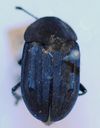
Aclypea bituberosa is a phytophagous carrion beetle in the Silphidae, notable for being herbivorous rather than necrophagous like most of its relatives. and larvae feed on leaves and shoots of various crop plants, particularly spinach and beets, causing occasional agricultural damage. The has a single per year, as adults. It is restricted to the northwestern quarter of North America.
Pronunciation
How to pronounce Aclypea bituberosa: //əˈklɪ.pi.ə baɪ.tuː.bəˈroʊ.sa//
These audio files are automatically generated. While they are not always 100% accurate, they are a good starting point.
Identification
The deeply cleft is the definitive character for Aclypea. A. bituberosa is distinguished from the only other North American , A. opaca (Beet Carrion Beetle), by its much broader distribution and by the pair of raised on the ; A. opaca is restricted to Alaska and the Northwest Territories. The three longitudinal ridges on each elytron also aid recognition.
Images
Habitat
Occurs on plains and in mountain meadows. and larvae are associated with plants in agricultural fields and weedy areas.
Distribution
Northwestern quarter of the United States and adjacent southern Canada: British Columbia and Washington south to central California east of the Sierra Nevada, and eastward to northeast Nebraska and southeast Manitoba. More common east of the Continental Divide than in the Pacific Northwest.
Seasonality
active from March through November. Adults emerge early in spring, with peak damage to beets and spinach occurring in May. One per year.
Diet
and larvae feed on leaves and shoots of various plants. Crop include spinach, beets, pumpkin, squash, radish, rhubarb, potato, lettuce, cabbage, turnip, rapeseed, and wheat. Weedy hosts include lamb's quarters, povertyweed, and other Chenopodiaceae, plus nightshade (Solanaceae).
Host Associations
- Spinacia oleracea - feeds onsuffers most damage in May
- Beta vulgaris - feeds onsuffers most damage in May
- Chenopodium album - feeds onlamb's quarters
- Solanum - feeds onnightshade
Life Cycle
One per year. Females lay in soil shortly after spring ; eggs hatch in about one week. Larvae feed during the day on plant foliage, hiding in soil at night. Three instars: first two each last ~5 days, third instar lasts ~15 days. occurs in soil at 1–2 inches depth; emerges in ~3 weeks. Adults overwinter.
Behavior
Larvae exhibit feeding , retreating to soil at night. are active on the ground surface and on plants.
Ecological Role
Herbivore in agricultural and . Unusual among Silphidae for being phytophagous rather than carrion-feeding.
Human Relevance
Occasional agricultural pest, particularly of spinach and beet crops. Damage is most significant in May.
Similar Taxa
- Aclypea opacaAlso has cleft , but restricted to Alaska and Northwest Territories; A. bituberosa has broader distribution and elytral
- Other SilphidaeMost carrion beetles are necrophagous and lack the cleft ; A. bituberosa is distinguished by herbivorous habit and diagnostic labral notch
More Details
Taxonomic note
Despite the 'carrion beetle,' this is phytophagous. The Silphidae contains both necrophagous and herbivorous members.
Family classification discrepancy
Some sources (GBIF, iNaturalist, Catalogue of Life) list Staphylinidae as the , but this is erroneous; A. bituberosa is correctly placed in Silphidae.