
Anisotoma
Fenzl, 1844
slime mold beetles, round fungus beetles
Species Guides
11- Anisotoma amica(round fungus beetle)
- Anisotoma basalis
- Anisotoma blanchardi(round fungus beetle)
- Anisotoma confusa
- Anisotoma discolor(round fungus beetle)
- Anisotoma errans
- Anisotoma expolita
- Anisotoma geminata
- Anisotoma humeralis(round fungus beetle)
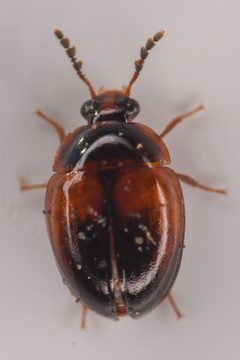
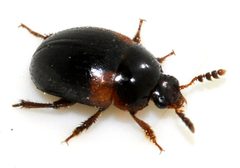
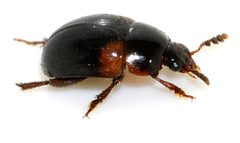
Anisotoma is a of small beetles in the Leiodidae, commonly known as slime mold beetles or round fungus beetles. The genus contains at least 20 described , with six monophyletic species groups comprising 35 known species including 13 described in a 1979 revision. These beetles are specialized associates of slime molds (Myxomycetes). The genus originated in North America from a Holarctic common ancestor shared with the related genus Agathidium, subsequently dispersing to Palearctic and Central American regions.
Pronunciation
How to pronounce Anisotoma: //ˌæn.ɪˈsoʊ.tə.mə//
These audio files are automatically generated. While they are not always 100% accurate, they are a good starting point.
Images
Habitat
Forested and moist environments where slime molds (Myxomycetes) occur; associated with decaying wood, leaf litter, and other substrates supporting myxomycete growth.
Distribution
Holarctic distribution with origin in North America; present in Palearctic and Central American regions. Specific distributions vary: North America (ancestral region), Eurasia, and Mexico (including described species from Hidalgo, Colima, and Autlán regions).
Diet
Specialized feeding on slime molds (Myxomycetes).
Host Associations
- Myxomycetes - food sourceslime molds are the primary nutritional substrate for larvae and
Ecological Role
Primary consumers of slime molds; contribute to nutrient cycling in forest through consumption and processing of myxomycete .
Similar Taxa
- AgathidiumProbable sister group of Anisotoma; shares Holarctic common ancestor and similar ecological association with fungi/slime molds. Distinguished by morphological characters detailed in systematic revisions.
- EucyrtaFormerly recognized as a separate Japanese , now synonymized with Anisotoma based on cladistic analysis.
Misconceptions
The name Anisotoma has been applied to both a plant genus (Apocynaceae, South African succulents) and this genus (Leiodidae). These are homonyms representing entirely unrelated organisms—one a flowering plant, the other a beetle. The beetle genus Anisotoma was established prior to widespread recognition of the plant genus in zoological literature.
More Details
Taxonomic history
The has undergone significant revision; the Japanese genus Eucyrta was synonymized with Anisotoma, and the A. obsoleta was renamed A. homi due to preoccupation. Six monophyletic species groups are recognized: the classification includes species groups defined by morphological and presumably ecological traits.
Speciation rate
Speciation in Anisotoma may occur rapidly, estimated at 10,000 to 1,000,000 years based on phylogenetic analysis.