
Pinodytes newelli
(Hatch, 1957)
Pronunciation
How to pronounce Pinodytes newelli: //pɪˈnɒdaɪtiːz ˈnjuːwɛli//
These audio files are automatically generated. While they are not always 100% accurate, they are a good starting point.
Identification
Distinguished from surface-dwelling beetles by the complete absence of . Separated from other eyeless soil beetles by geographic range (Pacific Northwest USA) and by subtle morphological characters of the Pinodytes, including antennal and mouthpart structure. The original description by Hatch (1957) as Catopocerus newelli provides diagnostic features, but these require examination.
Images
Appearance
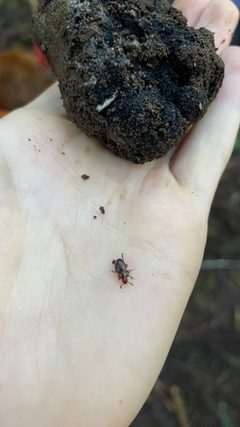
Small with complete absence of . Body form typical of soil-dwelling leiodids: compact, somewhat flattened, with short appendages adapted for moving through soil spaces. likely pale or lightly pigmented, consistent with subterranean .
Habitat
Soil , specifically the spaces of mineral soil. The occupies the deep soil layer, below the surface organic horizon, in forested or naturally vegetated areas of the Pacific Northwest.
Distribution
to the Pacific Northwest region of the United States. Documented from Oregon and Washington. The restricted range suggests association with specific soil conditions or forest types in this region.
Diet
Fungivore; feeds on fungal and spores in soil.
Behavior
Subterranean; spends entire in soil, moving through pore spaces between soil particles. Activity patterns unknown, but likely continuous given stable subterranean conditions.
Ecological Role
Contributes to soil nutrient cycling through consumption of fungal . As a specialized fungivore, it helps regulate fungal and facilitates decomposition processes in soil .
Human Relevance
No direct economic or medical significance. Of interest to soil ecologists and coleopterists studying subterranean biodiversity. The is rarely encountered due to its deep soil .
Similar Taxa
- Other Pinodytes speciesShare eyeless condition and soil ; require examination of genitalia and other fine morphological characters for separation
- Catopocerus speciesClosely related within same ; historically confused with Pinodytes (this was originally described as Catopocerus newelli)
- Other eyeless Leiodidae (e.g., Platycholeus)Similar subterranean adaptations but differ in body form, geographic distribution, and antennal structure
More Details
Taxonomic history
Originally described by Hatch in 1957 as Catopocerus newelli, later transferred to Pinodytes. This reclassification reflects ongoing refinement of generic boundaries within the Catopocerinae.
Collection and study challenges
The is rarely collected due to its deep soil . Standard surface sampling methods fail to capture it; specialized techniques such as soil washing, flotation, or deep soil core extraction are required.