
Catopocerinae
Hatch, 1927
Tribe Guides
2- Catopocerini
- Glacicavicola(Western Blind Cave Beetle)
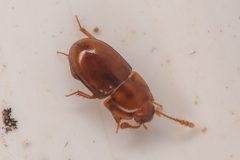
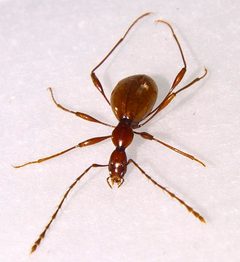
Catopocerinae is a of small beetles within Leiodidae, containing at least two extant —Catopocerus and Pinodytes—in North America, plus the extinct genus Archaeocerus from Cretaceous Myanmar amber. All described extant are eyeless and wingless, inhabiting forest soil and litter. The subfamily has been revised taxonomically with numerous new species described, particularly in western North America.
Pronunciation
How to pronounce Catopocerinae: /ˌkætəˌpoʊsəˈraɪniː/
These audio files are automatically generated. While they are not always 100% accurate, they are a good starting point.
Identification
Members are distinguished from other Leiodidae by the combination of complete eyelessness, winglessness, and small body size. The structure provides diagnostic characters for placement. Extant North American are assigned to either Catopocerus (east of Mississippi River) or Pinodytes (west of Mississippi River) based on geography and .
Images
Habitat
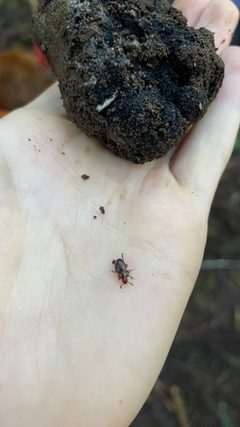
Forest soil and litter. All extant are subterranean or ground-dwelling inhabitants of forested environments.
Distribution
North America, with divided by the Mississippi River: Catopocerus species occur east of the Mississippi, while Pinodytes species occur west of the Mississippi. Documented from Oregon, California, Washington, Idaho, Alaska, Colorado, Texas (Ozarks region to eastern Texas), and British Columbia (Haida Gwaii Islands). The extinct Archaeocerus is known from Cretaceous Myanmar amber.
Diet
Subterranean fungi. Both larvae and have been observed to probably feed on subterranean fungi.
Behavior
Eyeless and wingless; adapted to subterranean or soil-surface existence.
Ecological Role
Soil fungivore. Functions as a decomposer in forest soil through .
Similar Taxa
- Other Leiodidae subfamiliesCatopocerinae differs in being consistently eyeless and wingless, whereas related typically retain and wings.
- Catopocerus vs. PinodytesGeographically separated by the Mississippi River; Pinodytes was resurrected from synonymy based on morphological distinctions.
Sources and further reading
- BugGuide
- iNaturalist taxon
- NCBI Taxonomy
- Catalogue of Life
- Systematics, distributions and bionomics of the Catopocerini (eyeless soil fungivore beetles) of North America (Coleoptera: Leiodidae: Catopocerinae)
- Figure 1 from: Perreau M, Njunjić I, de Groot MD, Van Caenegem W, Haelewaters D (2025) Redescription of the Cretaceous species Archaeocerus uenoi Perreau, 2019 based on synchrotron radiation micro-tomography and nano-tomography (Coleoptera, Leiodidae, Catopocerinae). Subterranean Biology 52: 187-200. https://doi.org/10.3897/subtbiol.52.154293
- Supplementary material 2 from: Perreau M, Njunjić I, de Groot MD, Van Caenegem W, Haelewaters D (2025) Redescription of the Cretaceous species Archaeocerus uenoi Perreau, 2019 based on synchrotron radiation micro-tomography and nano-tomography (Coleoptera, Leiodidae, Catopocerinae). Subterranean Biology 52: 187-200. https://doi.org/10.3897/subtbiol.52.154293
- Figures 12-15 from: Perreau M, Njunjić I, de Groot MD, Van Caenegem W, Haelewaters D (2025) Redescription of the Cretaceous species Archaeocerus uenoi Perreau, 2019 based on synchrotron radiation micro-tomography and nano-tomography (Coleoptera, Leiodidae, Catopocerinae). Subterranean Biology 52: 187-200. https://doi.org/10.3897/subtbiol.52.154293
- Figures 5- 6 from: Perreau M, Njunjić I, de Groot MD, Van Caenegem W, Haelewaters D (2025) Redescription of the Cretaceous species Archaeocerus uenoi Perreau, 2019 based on synchrotron radiation micro-tomography and nano-tomography (Coleoptera, Leiodidae, Catopocerinae). Subterranean Biology 52: 187-200. https://doi.org/10.3897/subtbiol.52.154293
- Figures 10- 11 from: Perreau M, Njunjić I, de Groot MD, Van Caenegem W, Haelewaters D (2025) Redescription of the Cretaceous species Archaeocerus uenoi Perreau, 2019 based on synchrotron radiation micro-tomography and nano-tomography (Coleoptera, Leiodidae, Catopocerinae). Subterranean Biology 52: 187-200. https://doi.org/10.3897/subtbiol.52.154293
- Figures 7-9 from: Perreau M, Njunjić I, de Groot MD, Van Caenegem W, Haelewaters D (2025) Redescription of the Cretaceous species Archaeocerus uenoi Perreau, 2019 based on synchrotron radiation micro-tomography and nano-tomography (Coleoptera, Leiodidae, Catopocerinae). Subterranean Biology 52: 187-200. https://doi.org/10.3897/subtbiol.52.154293
- Figures 21-23 from: Perreau M, Njunjić I, de Groot MD, Van Caenegem W, Haelewaters D (2025) Redescription of the Cretaceous species Archaeocerus uenoi Perreau, 2019 based on synchrotron radiation micro-tomography and nano-tomography (Coleoptera, Leiodidae, Catopocerinae). Subterranean Biology 52: 187-200. https://doi.org/10.3897/subtbiol.52.154293
- Figures 2-4 from: Perreau M, Njunjić I, de Groot MD, Van Caenegem W, Haelewaters D (2025) Redescription of the Cretaceous species Archaeocerus uenoi Perreau, 2019 based on synchrotron radiation micro-tomography and nano-tomography (Coleoptera, Leiodidae, Catopocerinae). Subterranean Biology 52: 187-200. https://doi.org/10.3897/subtbiol.52.154293
- Supplementary material 1 from: Perreau M, Njunjić I, de Groot MD, Van Caenegem W, Haelewaters D (2025) Redescription of the Cretaceous species Archaeocerus uenoi Perreau, 2019 based on synchrotron radiation micro-tomography and nano-tomography (Coleoptera, Leiodidae, Catopocerinae). Subterranean Biology 52: 187-200. https://doi.org/10.3897/subtbiol.52.154293
- Figures 16-20 from: Perreau M, Njunjić I, de Groot MD, Van Caenegem W, Haelewaters D (2025) Redescription of the Cretaceous species Archaeocerus uenoi Perreau, 2019 based on synchrotron radiation micro-tomography and nano-tomography (Coleoptera, Leiodidae, Catopocerinae). Subterranean Biology 52: 187-200. https://doi.org/10.3897/subtbiol.52.154293