
Pinodytes gibbosus
Peck & Cook, 2011
Pinodytes gibbosus is a small, eyeless soil-dwelling in the Leiodidae. It inhabits leaf litter in California and feeds on fungi. The was formally described in 2011, making it a relatively recent addition to the taxonomic literature. Its lack of and subterranean habits reflect adaptations to a life spent primarily in dark, decomposing organic matter.
Pronunciation
How to pronounce Pinodytes gibbosus: //pɪˈnɒd.iːˌtiːz ɡɪˈboʊ.səs//
These audio files are automatically generated. While they are not always 100% accurate, they are a good starting point.
Identification
Pinodytes gibbosus can be distinguished from other Pinodytes by subtle morphological features described in the original description (Peck & Cook, 2011), including the convex ('gibbose') body shape referenced in its name. It is separated from other small soil beetles by its combination of eyelessness, fungivorous habits, and membership in the Leiodidae rather than Staphylinidae or other similar families. Accurate identification to species level requires examination by a , as Catopocerinae species are morphologically conservative and difficult to distinguish without detailed study.
Images
Appearance
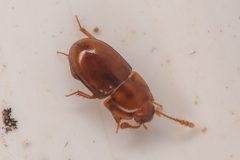
A small with no , consistent with its soil-dwelling lifestyle. As a member of the Catopocerinae, it likely has a compact, somewhat humpbacked body form (the specific epithet 'gibbosus' refers to a humped or convex shape). The body is probably pale or unpigmented, typical of eyeless, subterranean beetles. Detailed morphological descriptions beyond these general characteristics have not been widely published.
Habitat
Inhabits leaf litter in forested or wooded areas. As an eyeless soil fungivore, it occupies the interface between soil and decomposing plant material, where fungal resources are abundant. The microhabitat is dark, moist, and rich in organic matter.
Distribution
to California, USA. Known from specific localities within the state where suitable leaf litter occurs.
Diet
Fungivore—feeds on fungi in soil and leaf litter. The specific fungal consumed have not been documented.
Behavior
Little is known of specific . As a subterranean, eyeless , activity is presumably concentrated in the moist, dark layers of leaf litter and upper soil horizons. Movement and foraging likely occur in response to fungal resource distribution and moisture conditions.
Ecological Role
Contributes to decomposition processes in forest through . By consuming fungi in leaf litter, it participates in nutrient cycling and the breakdown of organic matter. Its role in as prey for larger soil-dwelling has not been documented.
Human Relevance
No direct human relevance. Not an agricultural pest or beneficial in managed systems. Of interest primarily to coleopterists and ecologists studying soil fauna and decomposition processes.
Similar Taxa
- Other Pinodytes speciesMorphologically similar eyeless soil beetles in the same ; require examination for separation
- Catopocerinae (other genera)Other eyeless leiodid beetles with similar subterranean habits; -level characters separate them from Pinodytes
- Small StaphylinidaeSuperficially similar soil-dwelling beetles, but distinguished by -level characters including wing venation and abdominal structure
More Details
Taxonomic recency
Described in 2011 by Peck & Cook, making it one of the more recently described in the diverse but taxonomically challenging Catopocerinae.
Conservation status
Not formally assessed. As a California with specific leaf litter requirements, it may be vulnerable to habitat loss from urbanization, agriculture, and changes in forest management practices, but no data exist.