
Omorgus scabrosus
(Palisot de Beauvois, 1818)
Omorgus scabrosus is a of hide beetle in the Trogidae, found across much of North America from Canada to Mexico. The species belongs to a family specialized in feeding on dried animal remains. Its distribution spans diverse including grasslands, woodlands, and desert edge environments.
Pronunciation
How to pronounce Omorgus scabrosus: //oʊˈmɔrɡəs skəˈbroʊsəs//
These audio files are automatically generated. While they are not always 100% accurate, they are a good starting point.
Identification
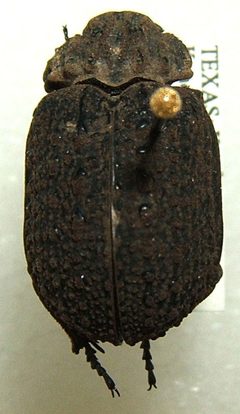
Distinguished from other North American Trogidae by the combination of: strongly tuberculate and roughened elytral surface with coarse, irregular punctation; pronotum with dense, coarse punctures and distinct marginal bead; overall dark, dull coloration without metallic reflections. Differs from Omorgus nodosus by the more irregular, less nodose elytral sculpturing. Separated from Trox by the absence of well-developed stridulatory ridges on the mesosternum and the more robust, less flattened body form.
Images
Habitat
Found in open including prairies, grasslands, scrublands, and woodland edges. Associated with areas where vertebrate carcasses occur, including natural landscapes and rural environments. Occurs from sea level to moderate elevations in mountainous regions.
Distribution
Nearctic: Canada (Ontario), United States (Colorado, Florida, Indiana, Iowa, Kansas, Kentucky, Maryland, Nebraska, New York, Oklahoma, South Carolina, Texas, Wisconsin), and Mexico (Sonora).
Diet
Feeds on dried animal remains, including bones, hides, hair, and desiccated carcass material. Has been observed feeding on dried dog .
Behavior
Nocturnally active. have been observed on sand substrates at night. Attracted to ultraviolet light.
Ecological Role
Scavenger and decomposer; contributes to nutrient cycling by breaking down dry animal remains that resist rapid decomposition by other organisms.
Human Relevance
Of minor forensic interest due to association with carcass remains. Occasionally encountered by entomologists during collecting with lights or by searching sandy .
Similar Taxa
- Omorgus nodosusOverlapping distribution in southwestern U.S.; distinguished by more regularly nodose elytral and generally larger, more prominent pronotal tubercles
- Trox spp.Sympatric throughout range; separated by presence of stridulatory ridges on mesosternum in Trox, and generally more flattened, less robust body form
More Details
Taxonomic History
Originally described by Palisot de Beauvois in 1818. The Omorgus was historically treated as a subgenus of Trox but is now recognized as distinct based on morphological and molecular evidence.
Collection Notes
Best collected by searching with ultraviolet lights or by examining sandy areas near animal remains. Daytime collecting by beating vegetation near carcass sites has also proven effective.