
Hypothyce
Howden, 1968
May beetles, Junebugs
Species Guides
1- Hypothyce mixta(East Texas Hypothyce)
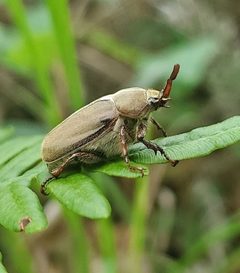
Hypothyce is a of scarab beetles in the Melolonthinae, containing four described in the United States. All species are restricted to isolated sandhill along the North American Coastal Plain. The genus exhibits pronounced geographic isolation, with each species known from a single state: Texas, Georgia, or Alabama. Several species remain poorly known, with females undescribed for three of four species.
Pronunciation
How to pronounce Hypothyce: /hɪˈpɒθɪsi/
These audio files are automatically generated. While they are not always 100% accurate, they are a good starting point.
Identification
within Hypothyce are distinguished by geographic distribution, body size, and setal characteristics. Hypothyce rayi is the smallest (17.3–18.7 mm) and has dense yellowish-white setae that obscure the , along with a blunt-edged scutellum. Males of all species are capable of ; females of H. mixta are flightless, and females of other eastern species are speculated to share this trait based on phylogenetic inference.
Images
Habitat
Restricted to isolated sandhill along the North American Coastal Plain. Specific habitat types include longleaf pine/sand ridge (H. rayi), sandhills with sparse hardwood, pine, and herbaceous vegetation (H. mixta), upland sandhills (H. burnei), and relictual fossil dunes (H. osburni). All habitats share well-drained sandy soils.
Distribution
Nearctic region, specifically the southeastern United States. Hypothyce mixta: Texas. Hypothyce burnei: Georgia (Monroe, Bibb, Jones, Wilkinson, Taylor Counties). Hypothyce osburni: Georgia (Dougherty County, Flint River region near Albany). Hypothyce rayi: Alabama (Hale County).
Seasonality
active mid to late July. Activity period appears limited; unsuccessful surveys in August 2022 suggest either narrow seasonal window or sensitivity.
Life Cycle
stage documented mid to late July. Larval stages and complete duration unknown. Females of H. mixta are flightless; females of H. rayi, H. burnei, and H. osburni remain undescribed.
Behavior
Males are capable of and have been collected using various methods: H. rayi found resting on vegetation at night, H. burnei attracted to porch lights and collected by beating dead pines, H. osburni captured in blacklight traps. Females of eastern speculated to be flightless based on H. mixta.
More Details
Taxonomic history
established by Howden in 1968 with description of H. mixta. Most recently, H. rayi was described by MacGown & Hill in 2023 from Alabama, bringing the total to four .
Conservation implications
All four exhibit extreme geographic restriction to isolated sandhill patches, suggesting vulnerability to fragmentation and loss. Limited survey success outside narrow temporal windows indicates potential sensitivity to environmental conditions.