
Hoplia trivialis
Harold, 1869
Dark hoplia
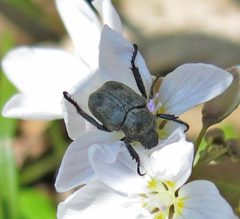
Hoplia trivialis, commonly known as the dark hoplia, is a of scarab beetle in the Scarabaeidae. It is native to North America and has been documented across a broad range of eastern and central United States. The species is relatively poorly studied compared to other scarab beetles, with limited published information on its and .
Pronunciation
How to pronounce Hoplia trivialis: /ˈhɔp.li.a trɪˈviː.a.lɪs/
These audio files are automatically generated. While they are not always 100% accurate, they are a good starting point.
Identification
Distinguished from other Hoplia by its generally darker coloration, consistent with its 'dark hoplia.' The Hoplia is characterized by small to medium-sized scarab beetles with clubbed and often metallic or dull coloration. Specific diagnostic features for H. trivialis require examination of genitalia and subtle morphological characters; accurate identification typically requires comparison with reference specimens or expert verification.
Images
Distribution
Documented from 19 U.S. states: Alabama, Colorado (uncertain), Connecticut, Georgia, Illinois, Indiana, Iowa, Kentucky, Maryland, Massachusetts, Mississippi, New Hampshire, New Jersey, North Carolina, Pennsylvania, Rhode Island, South Carolina, Tennessee, Texas, Virginia, and Wisconsin. Distribution spans the eastern and central United States, with records concentrated in the Northeast, Mid-Atlantic, and Midwest regions.
Similar Taxa
- Hoplia disparOverlapping geographic range in eastern North America; both are small scarab beetles requiring careful examination to distinguish.
- Hoplia callipygeAnother North American Hoplia with similar size and general ; coloration and specific structural features differ.
- Hoplia modestaShares eastern North American distribution; subtle differences in elytral and coloration aid separation.
More Details
Taxonomic Note
The was described by Edgar Harold in 1869. The Hoplia contains approximately 300 species worldwide, with several species present in North America. Many Hoplia species are poorly differentiated in standard field guides.
Data Limitations
Despite being a recognized for over 150 years, H. trivialis has received minimal focused study. The 52 iNaturalist observations suggest it is encountered with moderate frequency, but published biological accounts are scarce.