
Megasoma punctulatum
Cartwright, 1952
Arizona elephant beetle
Megasoma punctulatum, commonly known as the Arizona elephant beetle, is a of rhinoceros beetle in the Scarabaeidae. It is a member of the Megasoma, which includes some of the largest and heaviest beetles in the Americas. Like other members of its genus, this species exhibits strong , with males bearing prominent horns on the and pronotum that are used in combat with other males. The species is found in the southwestern United States and northwestern Mexico.
Pronunciation
How to pronounce Megasoma punctulatum: /ˌmɛɡəˈsoʊmə ˌpʌŋktʃʊˈleɪtəm/
These audio files are automatically generated. While they are not always 100% accurate, they are a good starting point.
Identification
Distinguished from other Megasoma by its punctate body surface and geographic distribution in Arizona and adjacent Mexico. Males distinguished from females by presence of horns. Separable from the more widely known Megasoma elephas (elephant beetle) by distribution and subtle morphological differences; M. punctulatum is restricted to the Arizona/Sonora region while M. elephas occurs further south in Central America. The specific epithet 'punctulatum' (meaning finely punctured or dotted) may refer to surface texture differences from related species.
Images
Appearance
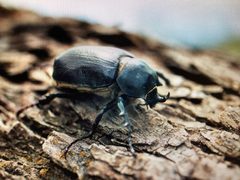
Large, heavy-bodied scarab beetle with robust, oval form. Males possess prominent horns on the and pronotum; females lack horns and are smaller. Body surface appears punctate (finely dotted), as indicated by the epithet. Coloration typically dark. Size substantial relative to most North American beetles, though exact measurements are not well documented in available sources.
Habitat
Associated with riparian and woodland in desert and semi-arid regions. likely found near decaying wood and fallen fruit. Larval habitat presumably in decaying wood or organic matter, based on known of .
Distribution
Nearctic region: southwestern United States (Arizona). Neotropical region: northwestern Mexico (Sonora). The has a restricted range centered on the Arizona-Sonora border region.
Seasonality
activity period not precisely documented, but likely active during summer monsoon season when conditions are favorable. Based on related , adults may be attracted to lights at night.
Diet
feed on fallen fruit and tree exudates. Larvae feed on decomposing wood and organic matter.
Life Cycle
Complete with , larva, pupa, and stages. Larval development likely extends over multiple years based on known of related Megasoma . Adults relatively short-lived compared to larval stage.
Behavior
Males use horns in combat with other males for access to mates and resources. When disturbed, may exhibit defensive tilting toward the ground, possibly to protect the vulnerable surface while presenting horns toward threats. are and attracted to light sources.
Ecological Role
Larvae contribute to decomposition and nutrient cycling in woodland . may serve as dispersers of fungal spores and bacteria associated with decaying fruit and wood.
Human Relevance
Occasional attraction to lights may bring into human habitation. Of interest to coleopterists and naturalists due to large size. No significant economic impact documented; neither a major pest nor a commercially exploited .
Similar Taxa
- Megasoma elephasLarger Central American with similar horned male ; distinguished by geographic distribution (Central America vs. Arizona/Sonora) and possibly subtle differences in horn structure and body surface texture
- Dynastes tityusAnother large eastern North American rhinoceros beetle with horned males; distinguished by different geographic range (eastern US), yellowish coloration, and different horn configuration
More Details
Taxonomic history
Described by Cartwright in 1952, making it a relatively recently described compared to many . The specific epithet 'punctulatum' refers to the finely punctured or dotted appearance of the body surface.
Conservation status
Not formally assessed for conservation status. Restricted range in the Arizona-Sonora border region may make vulnerable to alteration, though specific threats are not documented.
Sources and further reading
- BugGuide
- Wikipedia
- GBIF taxonomy match
- iNaturalist taxon
- Catalogue of Life
- Destination Toucan Ridge, Belize, to meet one of the largest beetles in the Americas: Elephant beetle, Megasoma elephas — Bug of the Week
- Big is Best but not for Bugs - Buglife Blog - Buglife
- Scarabaeidae | Beetles In The Bush | Page 3
- Archive — Bug of the Week