
Megasoma
Kirby, 1825
elephant beetles
Species Guides
3- Megasoma punctulatum(Arizona elephant beetle)
- Megasoma sleeperi(Sleeper's Elephant Beetle)
- Megasoma vogti(Texas elephant beetle)
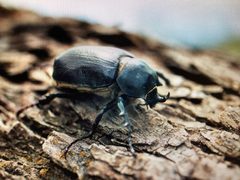
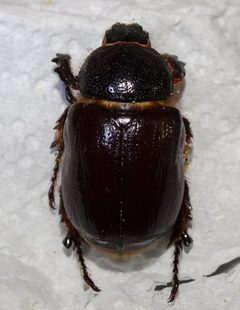
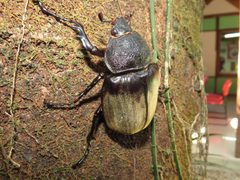
Megasoma is a of rhinoceros beetles (Dynastinae) commonly known as elephant beetles. The genus contains some of the largest in the Americas, with body lengths ranging from approximately 20 mm to 135 mm. Species are distributed from the southern United States through Central America to most of South America. Males of most species possess prominent horns used in combat with other males, while females are typically hornless and smaller. Many species have dense microscopic setae covering their bodies, giving them a pale or orange appearance.
Pronunciation
How to pronounce Megasoma: /meɪˈɡəsoʊmə/
These audio files are automatically generated. While they are not always 100% accurate, they are a good starting point.
Identification
Distinguished from other dynastine scarabs by combination of large size, presence of horns in males (absent in females of most ), and dense setal covering on many species. Males use horns in visible combat . Females can be confused with other large scarabs but lack horns and are generally larger than females of related . Separation of species within genus requires examination of horn , setal and distribution, and male genitalia.
Images
Habitat
Tropical and subtropical forests, woodlands, and associated . often found in trees. Larval habitat in decomposing wood and organic matter. Specific habitat associations vary by : Megasoma gyas restricted to Caatinga biome of northeastern Brazil; M. typhon in Mata Atlântica biome; M. hyperion in open Cerrado and transitional zones.
Distribution
Neotropical region. Range extends from southern half of North America (southern United States) through Central America to most of South America. -specific distributions: M. gyas in northeastern Brazil; M. typhon from Bahia to São Paulo states and Santa Catarina; M. hyperion in Minas Gerais, São Paulo, and southwestern Bahia; M. elephas and others in Central America including Belize.
Seasonality
active year-round in tropical regions; peak activity varies by locality. Attracted to lights at night. In temperate parts of range, adults active during warmer months.
Diet
Larvae feed on decomposing wood, tree roots, and organic matter. consume tree sap, fruit juices, and exudates from trees. Specific observations include feeding on fallen fruit and fermenting sap flows.
Life Cycle
Complete . Larvae C-shaped, typical of scarabaeiform pattern. Larval development reportedly takes up to three years in some . relatively short-lived, approximately three to four months. Larvae found in decaying wood, under bark of dead trees, and in decomposing vegetation.
Behavior
and strongly attracted to artificial lights. Males use horns in combat with other males for access to mates and resources. When disturbed, some tilt body toward ground and rotate horn toward perceived threat, possibly to protect surface. Adults often rest in trees during day. Adults possess sharp claws on leg tips that embed in substrates.
Ecological Role
Larvae function as decomposers, processing decaying wood and organic matter. may contribute to nutrient cycling through feeding on sap and fruit. Role in as prey for various ; larvae particularly vulnerable to and predators in decaying wood .
Human Relevance
Popular in pet trade due to large size and impressive appearance. Some command high prices (e.g., related large beetles up to $400). Subject of scientific study for , , and horn function. Attraction to lights makes them conspicuous and memorable for observers. Occasionally encountered in timber and woodworking contexts.
Similar Taxa
- DynastesAlso large dynastine scarabs with horned males; distinguished by different horn , geographic distribution, and lack of dense setal covering typical of many Megasoma
- PhileurusFlattened, parallel-sided body form resembles bess beetles (Passalidae); much smaller than most Megasoma and with different associations (under bark rather than in trees)
- GoliathusContains world's heaviest beetles; African distribution, not Neotropical; different body proportions and coloration
Misconceptions
Size alone does not indicate danger; despite formidable appearance, elephant beetles are harmless to humans. Horns are used for male-male combat, not for attacking humans or other animals. The name 'elephant beetle' refers to horn shape resembling an elephant's trunk, not to any ecological association with elephants.
More Details
Thermoregulation
Study of Megasoma gyas found that horns do not function as active heat dissipation structures. Regional heterothermy occurs even without exercise or stress, likely resulting from active flow control and passive heat dissipation through poorly insulated structures.
Taxonomic complexity
The M. gyas group has undergone recent revision, with M. gyas recognized as and restricted to Caatinga, 'long-horned M. gyas' separated as M. typhon, and 'short-horned M. gyas' described as new species M. hyperion.
Historical documentation
name from Greek megas (large) + soma (body). Historical accounts of large South American beetles date to Marcgraf's 1637-1644 expeditions and Piso & Marcgraf's 1648 Historia Naturalis Brasiliae.
Sources and further reading
- BugGuide
- Wikipedia
- GBIF taxonomy match
- iNaturalist taxon
- NCBI Taxonomy
- Catalogue of Life
- Destination Toucan Ridge, Belize, to meet one of the largest beetles in the Americas: Elephant beetle, Megasoma elephas — Bug of the Week
- Big is Best but not for Bugs - Buglife Blog - Buglife
- Scarabaeidae | Beetles In The Bush | Page 3
- Archive — Bug of the Week
- Revision of the Megasoma (Megasoma) gyas (Jablonsky in Herbst, 1785) species group (Coleoptera, Scarabaeidae, Dynastinae)
- STUDIES ON THE BIOLOGY OF <italic>BULIMNEA MEGASOMA</italic> (SAY) (GASTROPODA: PULMONATA)
- Regional heterothermy in Megasoma gyas is not related to active heat dissipation by the horns