
Cremastocheilus saucius
LeConte, 1858
anteater scarab beetle
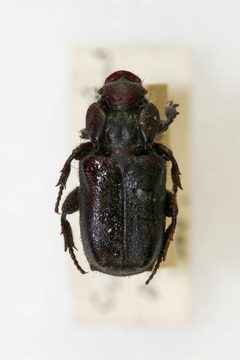
Cremastocheilus saucius is a of anteater scarab beetle in the Scarabaeidae. Like other members of its , it is a myrmecophile that lives within colonies as a of ant . The species is found in the southwestern and central United States and northern Mexico. It exhibits specialized morphological adaptations for surviving in hostile ant nest environments.
Pronunciation
How to pronounce Cremastocheilus saucius: //krɛˌmæstoʊˈkaɪləs ˈsaʊsiəs//
These audio files are automatically generated. While they are not always 100% accurate, they are a good starting point.
Identification
Distinguished from other Cremastocheilus by specific morphological characters; -level identification supported by the combination of: flattened angular body, dense pitted , concealed , and presence of pronotal trichomes. Species-level identification requires examination of detailed morphological features not fully described in available sources.
Images
Habitat
Associated with nest mounds, particularly those of mound-building ant . Found in areas with exposed soil and vegetation accumulation around ant colonies.
Distribution
Nearctic: United States (Colorado, Kansas, Nebraska, New Mexico, Texas, Wyoming); Neotropical: Mexico (Durango).
Seasonality
disperse in spring to find new colonies. New adults emerge from pupal in late summer or early fall and enter nests. Activity within nests resumes in spring when host ants become active.
Diet
feed on larvae and pupae. Larvae feed on decaying vegetation composted by ants in the nest periphery.
Host Associations
- Formica - /primary ; mound-building thatching ants
- Myrmecocystus - /honeypot ants
- Lasius - /cornfield ants
- Camponotus - /carpenter ants
Life Cycle
Females lay singly in soil around nest mound periphery. Larvae progress through three instars, feeding on decaying vegetation, and can defend themselves against ants with mandibular strikes and repulsive secretions from mandibular and anal glands. occurs in oval chambers constructed from soil particles. Complete cycle from egg to takes approximately four months. Newly emerged adults accumulate colony scent while moving to nest center, becoming chemically camouflaged.
Behavior
Employs death-feigning () to gain entry to nests: remains motionless with legs outstretched in areas trafficked by ants, who carry the apparently dead into the nest. are capable, fast fliers that crash-land near scouting ants during daytime .
Ecological Role
within colonies, regulating ant . Larvae contribute to decomposition of nest vegetation.
Human Relevance
No direct economic importance. Subject of entomological interest due to specialized myrmecophilous adaptations.
Similar Taxa
- Other Cremastocheilus speciesShare -level morphological traits including pronotal trichomes, concealed , and myrmecophilous lifestyle; distinguished by subtle morphological differences requiring expert examination
- Other ScarabaeidaeLack the flattened angular body form, dense pitted , and -associated adaptations of Cremastocheilus
Misconceptions
The glandular secretions from pronotal trichomes were originally interpreted as attractants or pacifiers; this function has not been confirmed and the trichomes remain functionally enigmatic.
More Details
Myrmecophilous adaptations
Multiple convergent adaptations for nest survival: chemical camouflage through acquisition of colony scent, mechanical armor against ant attacks, specialized for feeding on ant , and behavioral deception through death-feigning.
Population density
Excavated colonies typically yield 20-30 beetles or larvae, though some nests may up to 200 individuals.