
Cremastocheilus mexicanus
Schaum, 1841
Anteater scarab beetle
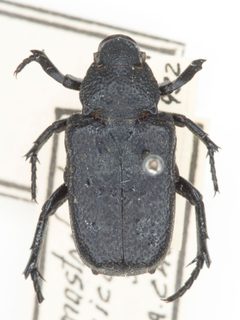
Cremastocheilus mexicanus is a myrmecophilous scarab beetle in the tribe Cremastocheilini. The is part of a of approximately 35 North American species known as 'anteater scarabs' for their specialized predatory relationship with ants. and larvae inhabit colonies where they feed on ant , exhibiting remarkable morphological and behavioral adaptations for this lifestyle. The species occurs in the southwestern United States and northern Mexico.
Pronunciation
How to pronounce Cremastocheilus mexicanus: /kreməstoʊˈkaɪləs mɛksɪˈkeɪnəs/
These audio files are automatically generated. While they are not always 100% accurate, they are a good starting point.
Identification
Distinguished from other Cremastocheilus by geographic range and subtle morphological differences; the is currently undergoing taxonomic revision. Separation from other scarab beetles is straightforward due to the unique combination of flattened body, dense sculptured , and pronotal trichomes. Within the genus, species identification requires examination of specific characters by .
Images
Habitat
Distribution
Nearctic region: recorded from Arizona, New Mexico, and Texas (USA). Neotropical region: recorded from Coahuila, Guanajuato, and Sonora (Mexico). The reaches its greatest abundance in the desert southwest.
Seasonality
emerge from pupal in late summer or early fall. Spring activity includes feeding on larvae within colonies. to locate new host colonies occur during favorable conditions, with peak observability in spring when adults are actively seeking new nests.
Diet
are specialized of larvae and pupae, piercing soft with modified and consuming liquefied tissues. Larvae feed on decaying vegetation that ants have composted within nest mounds; this material is derived from the plant debris accumulated by thatching ants.
Host Associations
- Formica - Primary , especially mound-building thatching ants
- Myrmecocystus - Honeypot ants, recorded as for
- Lasius - Cornfield ants, recorded as for
- Camponotus - Carpenter ants, recorded as for
- Pogonomyrmex - Harvester ants, southwestern records for
- Veromessor - Harvester ants, southwestern records for
- Aphaenogaster - Spine-waisted ants, southwestern records for
Life Cycle
Females lay singly in soil around the periphery of nest mounds. Larvae pass through three instars, feeding on composted vegetation within the ant mound. Larvae are capable of defensive , striking attacking ants with their and secreting repulsive liquids from mandibular and anal glands. occurs in oval chambers constructed from soil particles. The complete cycle from egg to requires approximately four months. Newly emerged adults accumulate colony scent while moving slowly toward the center of the nest, becoming chemically camouflaged. Adults overwinter in the ant nest, becoming active of ant in spring.
Behavior
employ (death-feigning) to gain entry to colonies: they remain motionless with legs outstretched in areas trafficked by scouting ants, who carry the apparent carrion into the nest. Adults are fast, capable fliers but crash-land in locations frequented by foraging ants. Within colonies, adults are largely ignored by ants due to chemical integration and defensive . Larvae are generally tolerated by ants and can defend themselves when attacked.
Ecological Role
Acts as a specialized within colonies, exerting top-down pressure on ant . The relationship represents a derived form of myrmecophily, with the functioning as a social that consumes resources. Population densities can be substantial, with excavated colonies yielding 20–30 individuals and some nests hosting up to 200 beetles or larvae.
Human Relevance
No direct economic importance. Of scientific interest as a model system for studying myrmecophily, chemical camouflage, and the evolution of social . The and its are rarely encountered by non- due to their cryptic lifestyle within nests. Occasionally found when ant colonies are excavated or exposed under stones and boards.
Similar Taxa
- Other Cremastocheilus speciesApproximately 35 in North America share the same fundamental body plan, myrmecophilous lifestyle, and morphological specializations; species-level identification requires expert examination
- Other Cetoniinae scarabsLack the flattened angular body, dense sculptured , pronotal trichomes, and modified mouthparts characteristic of Cremastocheilus
More Details
Trichome function
The hair brushes (trichomes) on the pronotum were originally hypothesized to secrete pacifying or attractive compounds for ants, but this interpretation has been challenged; their exact function remains unresolved
Taxonomic status
The Cremastocheilus is currently undergoing revision, and boundaries may be refined