
Cremastocheilus harrisii
Eastern Ant-loving Scarab
Cremastocheilus harrisii is a of anteater scarab beetle in the Scarabaeidae. As a member of the Cremastocheilus, it exhibits the specialized myrmecophilous lifestyle characteristic of this group, living within colonies and feeding on ant . The species is part of a genus of approximately 35 North American species that have evolved remarkable morphological and behavioral adaptations for surviving in hostile ant nest environments.
Pronunciation
How to pronounce Cremastocheilus harrisii: //ˌkrɛməstoʊˈkaɪləs ˈhɛrɪˌsaɪiː//
These audio files are automatically generated. While they are not always 100% accurate, they are a good starting point.
Identification
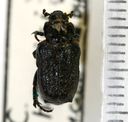
Distinguished from other scarab beetles by its small size (approximately 10 mm), dull black coloration, flattened and angular body form, and heavily armored, pitted . The presence of trichomes on the pronotum is a -level characteristic. Within Cremastocheilus, identification requires examination of specific morphological details not readily summarized in available sources. Most reliably identified by its association with colonies, particularly those of mound-building Formica species.
Images
Habitat
Associated with nest mounds, particularly those constructed by thatching ants (Formica ) which create heaps of vegetation. Found in environments where ant colonies occur, including open areas with suitable soil conditions for mound construction. In the eastern United States, likely associated with deciduous forest edges and open woodlands where Formica ants are common.
Distribution
Eastern North America; specific range details beyond this general region are not clearly documented in available sources. The "Eastern -loving Scarab" suggests distribution in the eastern United States, distinguishing it from related that reach greatest diversity in the desert southwest.
Seasonality
disperse to find new colonies during spring. Newly emerged adults appear in late summer or early fall, enter nests, and become over winter. Active feeding on ant resumes in spring. Complete from to adult takes approximately four months.
Diet
feed on larvae and sometimes pupae. Larvae feed on decaying vegetation that ants have composted within their nest mounds.
Host Associations
- Formica - primary Mound-building thatching ants; primary for most Cremastocheilus
Life Cycle
Females lay singly in soil around the periphery of nest mounds. Larvae pass through three instars, feeding on decaying vegetation composted by ants. Larvae pupate in oval chambers constructed from soil particles. emerge in late summer or early fall, slowly move to the center of the ant nest while accumulating colony scent. Adults overwinter in the nest and begin feeding on ant in spring. Total development time from egg to adult is approximately four months.
Behavior
Employs death-feigning () to gain entry to nests: the becomes motionless with legs outstretched in areas trafficked by scouting ants, which carry the apparently dead insect into the nest as food. Larvae defend themselves against attacking ants by striking with their jaws and secreting repulsive liquids from mandibular and anal glands. are capable of strong, fast but crash-land in areas frequented by scouting ants.
Ecological Role
within colonies, functioning as a specialized myrmecophile that exploits the resources and protective environment of ant nests. The relationship is parasitic rather than mutualistic, with beetles consuming ant while contributing no apparent benefit to the colony.
Human Relevance
No direct economic or medical significance to humans. Of interest to entomologists and naturalists due to its remarkable behavioral and morphological adaptations for myrmecophily. Rarely encountered by casual observers due to its cryptic lifestyle within nests.
Similar Taxa
- Other Cremastocheilus speciesShare the same general body plan, myrmecophilous lifestyle, and morphological adaptations. C. harrisii distinguished by eastern distribution and specific morphological details requiring expert examination.
- Other ScarabaeidaeMost scarab beetles lack the extreme body flattening, angular form, dense pitted , and specialized mouthpart modifications for on .
More Details
Trichome function
The trichomes on the pronotum were originally hypothesized to secrete a substance that attracted or pacified ants. This interpretation has been rejected, and the true function of these structures remains unknown.
Mouthpart specialization
The are modified into sharp appendages that pierce the soft of larvae and pupae. The are much reduced and function only to help transport liquid food to the mouth. The enlarged, shield-like protects these structures from below.
Colony scent acquisition
Newly emerged accumulate colony scent as they move slowly to the center of the nest, presumably rendering themselves chemically inconspicuous to .