
Acrossus rufipes
(Linnaeus, 1758)
Night-flying Dung Beetle
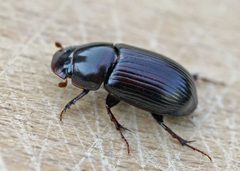
Acrossus rufipes is a scarab beetle commonly known as the night-flying . The is notable for its strong negative , remaining buried in soil or during daylight and emerging only after dark to fly and seek food or mates. It is among the largest members of its , with a robust body adapted for burrowing using its shovel-shaped . The species has experienced taxonomic instability, having been classified under Aphodius before returning to Acrossus.
Pronunciation
How to pronounce Acrossus rufipes: /əˈkrɒsəs ˈruːfɪˌpiːz/
These audio files are automatically generated. While they are not always 100% accurate, they are a good starting point.
Identification
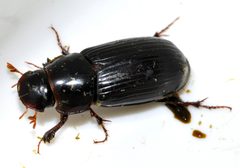
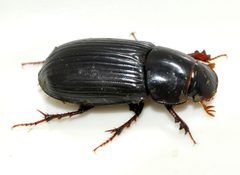
Distinguished from similar Aphodiinae by its relatively large size (9–13 mm), the combination of dark body with red-tinged legs, and the presence of ten elytral ridges. The shovel-shaped is distinctive within the . When encountered at artificial lights at night, its and association with help confirm identification.
Images
Appearance
Body length 9–13 mm, making it one of the largest in the . The surface ranges from dark brown to black. The legs are black with a distinct red tinge, which gives the species its Latin name rufipes ("red foot"). Each bears ten distinct ridges. The is shovel-shaped, an for moving soil while burrowing.
Habitat
Found in various types of , which serves as both food source and breeding substrate. During daylight hours, individuals burrow into moist soil or fresh dung to avoid light. The shows flexibility in dung type utilization.
Distribution
Palearctic region (Europe, North Africa, Asia including China, Japan, Korea, Kazakhstan, and Russia Far East) and North America (Canada: Ontario, Quebec; USA: Maryland, New Hampshire, North Carolina, Tennessee). Records also exist from India (Himachal Pradesh, Uttarakhand, Uttar Pradesh).
Seasonality
Active primarily from April through October in the British Isles. Activity is strictly ; from soil occurs after nightfall when light levels drop sufficiently to trigger emergence .
Diet
Feeds on various types of . The specific dietary components within dung are not detailed in available sources.
Life Cycle
Breeds in . Specific details regarding , larval, and pupal stages, duration of development, or number of per year are not documented in available sources.
Behavior
Exhibits strong negative . During daylight or under artificial light, individuals instinctively burrow into the nearest moist soil or fresh . Burrows to depths of at least 4 cm, from which they can detect the cessation of light and emerge to fly at night. Night are undertaken to locate mates and new food sources. Frequently attracted to artificial lights during these flights, which accounts for its .
Ecological Role
Functions as a -feeding , contributing to dung decomposition and nutrient cycling. Engages in a mutualistic relationship with at least one of mite, which attaches beneath the beetle's . The mites feed on mold in dung that would otherwise decompose the beetle's food source, while the beetle provides transport and protection.
Human Relevance
Sometimes considered a nuisance when attracted to artificial lights near human habitation during night . Its presence at lights is incidental to its natural rather than indicative of any direct economic impact.
Similar Taxa
- Aphodius speciesFormerly classified within Aphodius; A. rufipes is larger (9–13 mm vs. typically smaller) and distinguished by the red-tinged legs and ten elytral ridges
- Other Acrossus speciesA. rufipes is among the largest in the ; specific distinguishing characters for congeneric would require more detailed examination of male genitalia and other subtle morphological features
Sources and further reading
- BugGuide
- Wikipedia
- GBIF taxonomy match
- iNaturalist taxon
- NCBI Taxonomy
- Catalogue of Life
- Vanquished vanishing columbines: Columbine sawfly, Pristiphora rufipes — Bug of the Week
- Cicindelidae | Beetles In The Bush | Page 7
- Fungus Manipulates Ants to Die Near their Nests, Ensuring New Hosts
- Bug Eric: More Beetles from Bones
- Working with Cerceris fumipennis—Part 2 | Beetles In The Bush
- Red-eyed poop! | Beetles In The Bush