
Lichnanthe apina
Carlson, 1980
bumble bee scarab beetle
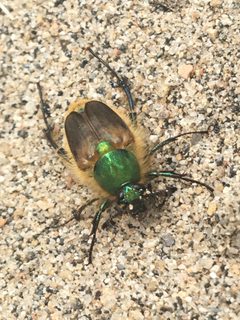
Lichnanthe apina is a scarab beetle in the Glaphyridae, commonly called a scarab beetle due to its resemblance to bumble bees. The was described by Carlson in 1980 and is to California, USA. Like other members of Glaphyridae, it likely exhibits of bumble bees as a defensive .
Pronunciation
How to pronounce Lichnanthe apina: /lɪkˈnænθi əˈpiːnə/
These audio files are automatically generated. While they are not always 100% accurate, they are a good starting point.
Identification
Distinguished from actual bumble bees by the presence of hardened forewings () meeting in a straight line down the back, and with plate-like terminal segments. Separated from other Glaphyridae by geographic restriction to California and subtle morphological features of the male genitalia and body proportions; precise identification requires examination.
Images
Appearance
are densely hairy, giving a -like appearance. The body is robust and covered with setae that create color patterns mimicking bumble bees (Bombus). are , typical of scarab beetles. Specific coloration details for this are not well documented in available sources.
Habitat
Found in coastal and near-coastal environments of California. Specific microhabitat preferences are poorly documented, but related glaphyrids are associated with sandy soils and open, sunny areas.
Distribution
to California, USA. Records are concentrated in coastal regions of the state.
Seasonality
activity period is not well documented; limited observational records suggest spring and early summer activity.
Behavior
are and active fliers. The -like appearance suggests , though this has not been experimentally verified for this specifically. Mimicry likely reduces by vertebrate that avoid stinging hymenopterans.
Ecological Role
may serve as of flowers they visit. Larval is unknown but glaphyrid larvae are generally soil-dwelling and may contribute to soil nutrient cycling.
Human Relevance
No documented economic importance. Occasionally noted by naturalists due to its striking -mimic appearance.
Similar Taxa
- Bombus (bumble bees)Visual mimicry; distinguished by membranous wings (not ), lack of , and constricted waist between and .
- Other Glaphyridae (e.g., Lichnanthe vulpina)Similar body form and hairiness; separated by geographic range and subtle morphological differences requiring detailed examination.
More Details
Taxonomic history
Described by David C. Carlson in 1980 based on specimens from California. The Lichnanthe contains few and is restricted to western North America.
Conservation status
Not formally assessed. Limited occurrence records and restricted range may warrant monitoring, though no specific threats are documented.