
Gnathoncus rotundatus
(Kugelann, 1792)
clown beetle
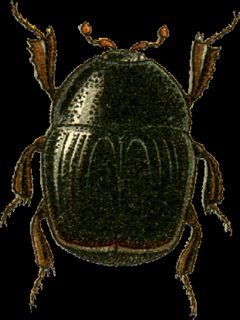
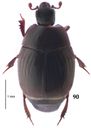
Gnathoncus rotundatus is a of clown beetle in the Histeridae. It is a small with a distribution spanning multiple continents. The species has been introduced to Australia and New Zealand. It is associated with poultry manure where it functions as a agent of fly pests.
Pronunciation
How to pronounce Gnathoncus rotundatus: /ˈnæθɒŋkəs roʊtʌnˈdeɪtəs/
These audio files are automatically generated. While they are not always 100% accurate, they are a good starting point.
Images
Habitat
Associated with poultry manure and other decaying organic matter. Found in manure pits of caged-layer poultry operations where it inhabits the surface layers of dry manure.
Distribution
Native to Europe, Northern Asia (excluding China), North America, South America, and Southern Asia. Introduced to Australia and New Zealand. Specific regional records include Russia (European and Far East), Armenia, Azerbaijan, Georgia, North Africa, Canary Islands, Afghanistan, Iran, Israel, Syria, Kazakhstan, Turkmenistan, Uzbekistan, Mongolia, Japan, China, Taiwan, Canada, USA, South Africa, St. Paul Island, and Chile.
Diet
of house fly and first-instar larvae. and immatures feed on eggs and early-stage larvae of manure-breeding flies.
Ecological Role
agent in poultry operations. Functions as a of pest fly , particularly house flies (Musca domestica). Present at lower population densities compared to the related Carcinops pumilio in poultry facilities.
Human Relevance
Used in programs for poultry operations to suppress manure-breeding fly . Reduces reliance on chemical in poultry facilities. Self-propagates when manure is kept dry and undisturbed.
Similar Taxa
- Carcinops pumilioAnother in the same found in poultry manure; distinguished by being more common and occurring at higher densities than Gnathoncus rotundatus
- Gnathoncus nanusClosely related congeneric also present in poultry facilities; distinguished by taxonomic separation at the species level
More Details
Conservation status
Not evaluated
Population dynamics in poultry facilities
Occurs naturally in poultry facilities but at lower numbers compared to Carcinops pumilio. Benefits from dry manure management practices that support .