
Carcinops pumilio
(Erichson, 1834)
poultryhouse pill beetle
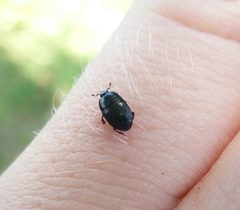
Carcinops pumilio is a small histerid widely distributed across Africa, Europe, Northern Asia, and North America. It is a specialized of filth flies, particularly house flies (Musca domestica) and little house flies (Fannia canicularis), consuming both and first-instar larvae. The has been extensively studied for its potential as a agent in poultry operations, where it inhabits manure accumulations. exhibit a distinctive prey-mediated , clinging to flies to locate ephemeral breeding resources more efficiently than by or flying alone.

Pronunciation
How to pronounce Carcinops pumilio: /kɑːrˈsɪnɒps pjuːˈmɪlioʊ/
These audio files are automatically generated. While they are not always 100% accurate, they are a good starting point.
Identification
Distinguished from other small black beetles in poultry environments by its compact, rounded histerid body form and association with manure . From other histerids, it may be separated by size (approximately 1/8 inch) and specific habitat context. The congeneric Gnathoncus nanus also occurs in poultry facilities but at lower densities. Accurate identification to species typically requires examination of genitalia or other microscopic features.
Images
Habitat
Primarily associated with poultry manure in caged-layer and broiler houses, where it inhabits surface layers of manure accumulations. Also found in other ephemeral organic substrates that support filth fly breeding, including decaying organic matter and refuse. Requires moist to moderately dry manure conditions; are supported by undisturbed manure accumulations maintained over extended periods.
Distribution
Native to: Europe (widespread, including Azores, Madeira, Canary Islands), Russia (European to Far East), Armenia, Georgia, Uzbekistan, North Africa, Japan, Korea, China, Taiwan. Introduced to: North America (Canada, USA), Chile, Cuba, Colombia (uncertain), Cape Verde Islands, Fiji, Vanuatu. Established in poultry facilities across multiple continents.
Seasonality
Active year-round in suitable conditions within heated poultry facilities. In temperate outdoor environments, activity likely seasonal but continuous in climate-controlled agricultural settings. shows seasonal variation, with peak dispersal activity correlating with fly .
Diet
of filth fly and first-instar larvae. Documented prey includes house fly (Musca domestica) and little house fly (Fannia canicularis). have been observed to consume 13-24 house fly eggs per day. Both adult and stages are predatory.
Host Associations
- Musca domestica - preyHouse fly and first-instar larvae; primary prey in poultry environments
- Fannia canicularis - preyLittle house fly; documented as prey for -mediated transport and likely consumption
Life Cycle
Holometabolous development with two larval instars. to averages 20.5 days at 30°C, with total developmental time varying strongly with temperature ( 67 days at 17.5°C, 19 days at 30°C). Second instar longest, comprising 39% of total development. First instar experiences highest mortality (26%); pupal stage typically has no mortality. Total mortality approximately 50% before adult emergence. Adult females can live up to 140 days with high early survival decreasing with age. Newly emerged adults can survive 25.5 days without feeding.
Behavior
Exhibits prey-mediated : cling to wings and bodies of adult flies (Musca domestica and Fannia canicularis) to be transported to new manure patches. This phoretic-like is more efficient for locating ephemeral resources than or flying alone. Both adults and immatures inhabit surface layers of manure. Adults and larvae are active . Dispersal behavior shows seasonal variation.
Ecological Role
Significant agent of filth flies in poultry operations and other manure-associated . Functions as a -dependent that can substantially reduce fly through and larval . Part of a guild of manure-inhabiting predators including macrochelid mites (Macrocheles muscaedomesticae) and uropodid mites (Fuscuropoda vegetans). Contributes to natural suppression of nuisance and -vectoring fly populations.
Human Relevance
Important beneficial insect in programs for poultry operations. Used or encouraged as a agent to reduce house fly and little house fly , thereby decreasing fly nuisance, transmission risk, and reliance on chemical . Conservation of existing populations through dry manure management and minimization of broad-spectrum insecticide use is recommended. No documented negative impacts on human health or structures.
Similar Taxa
- Gnathoncus nanusAnother histerid in the same tribe (Paromalini) found in poultry environments; distinguished by lower and subtle morphological differences requiring microscopic examination
- Other HisteridaeMany histerid beetles share compact black body form; accurate identification of C. pumilio requires attention to size (~1/8 inch), specific (poultry manure), and geographic context, with definitive identification often requiring genitalia examination
More Details
Temperature-dependent development
Development rates vary significantly with temperature. Optimal development occurs at 32.5°C. At 17.5°C, development times are: 25.5 days, larva 37.7 days, pupa 42.8 days. At 30°C: egg 3.8 days, larva 6.0 days, pupa 9.7 days. Larval survival highest (98-100%) at 25.5-32.5°C; pupal survival highest (100%) at 30°C.
Population parameters
Intrinsic rate of natural increase (rm) = 0.065; time (T) = 50.019 days; net rate (Ro) = 20.191; sex ratio approximately 0.48 female:0.52 male.
Conservation in poultry systems
are best maintained by keeping manure dry (≤30% moisture), avoiding broad-spectrum applications to manure surfaces, and leaving manure undisturbed during fly-active periods to support population buildup. Native populations should be encouraged before considering augmentative releases of other agents.
Sources and further reading
- BugGuide
- Wikipedia
- GBIF taxonomy match
- iNaturalist taxon
- NCBI Taxonomy
- Poultry Pest Management - AgriLife Extension Entomology
- How can social media users help researchers with ecological or biodiversity studies?
- Prey-mediated Dispersal Behavior of Carcinops pumilio (Coleoptera: Histeridae)
- A Hister Beetle Carcinops pumilio (Erichson) (Insecta: Coleoptera: Histeridae: Dendrophilinae: Paromalini)
- Biology of the House Fly Predator Carcinops pumilio (Erichson) (Coleoptera: Histeridae)
- Temperature-dependent Development of Immature Carcinops pumilio (Coleoptera: Histeridae), a Predator of Musca domestica (Diptera: Muscidae)2
- Seasonal Variation inCarcinops pumilio(Coleoptera: Histeridae) Dispersal and Potential for Suppression of Dispersal Behavior