
Margarinotus obscurus
(Kugelann, 1792)
clown beetle
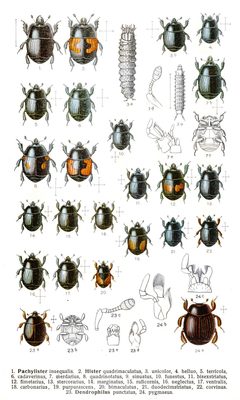
Margarinotus obscurus is a of clown beetle in the Histeridae. It has a broad geographic distribution spanning multiple continents, with native records across Europe, Northern Asia, Southern Asia, and Africa, and introduced in North America. The species was first described by Kugelann in 1792. Like other members of Histeridae, it is associated with decaying organic matter and carrion .
Pronunciation
How to pronounce Margarinotus obscurus: //ˌmɑːrɡəˈrɪnoʊtəs əbˈskjʊrəs//
These audio files are automatically generated. While they are not always 100% accurate, they are a good starting point.
Images
Distribution
Native to Europe (38 countries), Russia (European), Morocco, Armenia, Georgia, Turkey, Israel, Syria, Iran, Kyrgyzstan, Kazakhstan, Turkmenistan, Uzbekistan, and China (northeast). Introduced to North America, with records from British Columbia (Canada), Illinois, and Oregon (USA).
More Details
Taxonomic Note
The was originally described by Kugelann in 1792. GBIF records indicate it is an accepted species with exact name matching. The Margarinotus belongs to the tribe Histerini within the Histerinae.
Distribution Status
North American are considered introduced; the is native to the Palearctic region. The broad distribution across diverse climatic zones in Europe and Asia suggests ecological flexibility.