
Atholus bimaculatus
(Linnaeus, 1758)
Spotted Clown Beetle
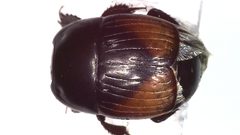
Atholus bimaculatus, commonly known as the spotted clown , is a of histerid beetle with a remarkably broad geographic distribution spanning multiple continents. The species is native to the Palearctic region (Europe, Northern Asia, North Africa) and has been introduced to North America, South America, and parts of Asia. It belongs to the Histeridae, a group commonly called clown beetles or hister beetles, which are typically associated with decomposing organic matter. The specific epithet 'bimaculatus' refers to two spots, likely describing a characteristic marking pattern on the .


Pronunciation
How to pronounce Atholus bimaculatus: //ˈæθ.oʊ.ləs ˌbaɪ.mæk.jʊˈleɪ.təs//
These audio files are automatically generated. While they are not always 100% accurate, they are a good starting point.
Identification
The can be distinguished from other Atholus species by the two spots (maculae) referenced in its specific epithet, though detailed diagnostic features require examination. As a member of Histeridae, it possesses the 's characteristic compact, oval body form with clubbed and shortened that may expose one or more abdominal tergites. Accurate identification to species level typically requires examination of genitalic structures and comparison with .
Images
Distribution
Native to the Palearctic region including Europe, Russia, North Africa (Canary Islands, Arabian Peninsula, Israel, Iran), and parts of East Asia (Japan, Korea, China). Also recorded from India, Myanmar, Yemen, Djibouti, Chad, Tanzania, Senegal, Kenya, and Cameroon. Introduced to North America (Canada: British Columbia to Quebec and New Brunswick; widespread in USA), Mexico, Guadeloupe, Brazil, Argentina, and Chile. The shows one of the widest distributions among Histeridae, with both native and introduced well established across temperate and tropical regions.
Similar Taxa
- Atholus confinisAnother widespread Atholus with overlapping distribution in the Palearctic; distinguished by differences in elytral punctation and male genitalia
- Atholus praetermissusSympatric in parts of Europe; requires careful examination of pronotal and elytral for separation
More Details
Taxonomic history
Originally described by Linnaeus in 1758, placing it among the earliest described . The Atholus was established to accommodate species formerly placed in Hister or related genera based on characters of the , , and male genitalia.
Introduction pathways
The ' presence in North and South America represents human-mediated introduction, likely through trade and transport of goods. Its establishment in the New World demonstrates the species' ecological flexibility and adaptability to novel environments.
Sources and further reading
- BugGuide
- Wikipedia
- GBIF taxonomy match
- iNaturalist taxon
- Catalogue of Life
- Please Pass the Chocolate Chirp Cookies | Bug Squad
- Home invaders III - Fall field cricket, Gryllus pennsylvanicus — Bug of the Week
- What’s all this chirping about? Ask the fall field cricket, Gryllus pennsylvanicus — Bug of the Week
- The troubadour downstairs – fall field cricket, Gryllus pennsylvanicus — Bug of the Week
- Field crickets invade a home with a wake-up call: Fall field cricket, Gryllus pennsylvanicus — Bug of the Week
- Cricket Virus Leads to Illegal Importation of Foreign Species for Pet Food