
Atholus
Thomson, 1859
Species Guides
9- Atholus americanus(clown beetle)
- Atholus bimaculatus(Spotted Clown Beetle)
- Atholus confinis
- Atholus falli(Atholus falli)
- Atholus minutus
- Atholus nubilus(clown beetle)
- Atholus perplexus(clown beetle)
- Atholus relictus(clown beetle)
- Atholus sedecimstriatus(clown beetle)
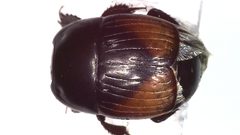
Atholus is a of clown beetles ( Histeridae) comprising more than 70 described . Members are found across the Palaearctic, Oriental, and Afrotropical regions, with documented occurrences in Europe, Asia, and the Philippines. Philippine species have been collected from ruminant and decaying organic matter.


Pronunciation
How to pronounce Atholus: /ˈæθoʊləs/
These audio files are automatically generated. While they are not always 100% accurate, they are a good starting point.
Identification
Atholus can be distinguished from other histerid by morphological features detailed in regional revisions; Philippine species are separated by genitalia structure and external as illustrated in taxonomic keys.
Images
Habitat
Lowland farms and pastures; decaying banana stumps; ruminant including cow and water buffalo dung; desiccated dung substrates.
Distribution
Palaearctic region (Europe, Asia including Tajikistan); Oriental region (China, Taiwan, Ryukyu Islands, Malaysia, Indonesia, Myanmar, Vietnam, India, Philippines); Afrotropical region (Comoros). Philippine records from Luzon, Mindoro, Panay, Guimaras, Negros, Cebu, Mactan, and Mindanao.
Behavior
Atholus coelestis is moisture-specific and has been found dwelling on desiccated . Atholus philippinensis has been observed in association with Platylister .
Similar Taxa
- PlatylisterAtholus philippinensis has been observed in association with Platylister , suggesting potential microhabitat overlap or co-occurrence in environments.
More Details
Taxonomic history
established by Thomson in 1859. Philippine revised in 2023 with redescriptions of A. torquatus, A. bakeri, A. nitidissimus, and diagnostic descriptions for A. coelestis and A. philippinensis.
Mite associations
Beetles of this the mite Lobogynium sudhiri ( Diplogyniidae), which completes its in and decaying organic matter.
Sources and further reading
- BugGuide
- Wikipedia
- GBIF taxonomy match
- iNaturalist taxon
- NCBI Taxonomy
- Catalogue of Life
- Redescription and neotype designation of Lobogynium sudhiri (Datta) (Acari: Diplogyniidae), a mite associated with beetles of the genus Atholus (Thomson) (Coleoptera: Histeridae) in the Palaearctic region
- Revision of the genus Atholus Thomson, 1859 (Coleoptera, Histeridae, Histerinae) from the Philippines with additional records.