
Teretrius
Erichson, 1834
clown beetles
Species Guides
6- Teretrius cylindrellus(clown beetle)
- Teretrius latebricola(clown beetle)
- Teretrius montanus
- Teretrius obliquulus
- Teretrius orbus(clown beetle)
- Teretrius placitus(clown beetle)
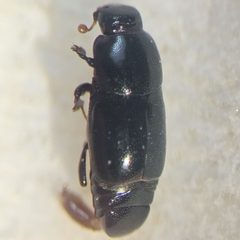
Teretrius is a of clown beetles ( Histeridae) comprising at least 70 described . The genus has gained significant attention due to the use of Teretrius nigrescens as a agent against the larger grain borer Prostephanus truncatus in Africa. Members of this genus are small predatory beetles associated with stored products and woodland . The genus was established by Erichson in 1834 and is classified within the Abraeinae.
Pronunciation
How to pronounce Teretrius: /tɛˈrɛtri.us/
These audio files are automatically generated. While they are not always 100% accurate, they are a good starting point.
Images
Habitat
Stored-product environments including farmers' maize stores; woodland in Africa where have established. Native populations occur in Mesoamerica and Central America. Efficacy of biological control varies by climate zone: effective in warm-humid areas, less effective in cool and hot-dry zones.
Distribution
Native to Mesoamerica and Central America, with distinct mitochondrial lineages (south and north clades) associated with geographical regions. Introduced to Africa for : south clade released in West Africa (Benin), north clade released in eastern Africa (Kenya). Established documented in at least 18 African countries by 2008. GBIF records indicate presence in Norway and Sweden, possibly representing or misidentified occurrences.
Seasonality
In southeastern Kenya, associated prey Prostephanus truncatus shows peak activity from November to January coinciding with short rains; activity presumably tracks prey availability.
Diet
of stored-product pests. Prostephanus truncatus is the most frequently detected prey in both native and introduced ranges. Sitophilus zeamais has been identified as secondary prey. and larvae exploit prey-specific contact to locate .
Host Associations
- Prostephanus truncatus - -preyprimary prey; target
- Sitophilus zeamais - -preysecondary prey identified via electrophoretic analysis
Life Cycle
Both and larval stages are active . Larvae show stronger behavioral response to prey than adults, with significant increases in residence time, distance covered, and path sinuosity in prey zones. Larval response lacks orthokinetic component present in adults, suggesting different foraging mechanisms.
Behavior
Arrested by dust and produced by prey boring into maize; this response is mediated by chemical cues extractable in hexane, methanol, and chloroform but not water. display inverse orthokinetic mechanisms and possible klinokinetic components contributing to arrestment. Larvae exhibit potential tropotactic and klinotactic mechanisms including backtracking at zone boundaries. documented in response to -baited traps.
Ecological Role
of serious post-harvest pests, particularly . As a agent, T. nigrescens achieved sustained reduction of over 80% in Prostephanus truncatus abundance over 5 years in Kenyan woodland and 77% reduction in laboratory growth.
Human Relevance
Major agent for Prostephanus truncatus, the most important pest of farm-stored maize in Africa. program initiated in 1992 in Kenya; established provide long-term, cost-effective pest suppression in suitable climate zones. Genetic monitoring recommended due to culturing-associated genetic drift and narrow genetic base in released populations.
Sources and further reading
- BugGuide
- Wikipedia
- GBIF taxonomy match
- iNaturalist taxon
- NCBI Taxonomy
- Catalogue of Life
- Phylogeographic structure of Teretrius nigrescens (Coleoptera: Histeridae) predator of the invasive post harvest pest Prostephanus truncatus (Coleoptera: Bostrichidae)
- Biological control of the larger grain borer Prostephanus truncatus (Coleoptera: Bostrichidae) in Kenya using a predatory beetle Teretrius nigrescens(Coleoptera: Histeridae)
- Prey-specific contact kairomones exploited by adult and larval Teretrius nigrescens: A behavioural comparison across different stored-product pests and different pest substrates
- Molecular markers reveal narrow genetic base and culturing-associated genetic drift inTeretrius nigrescensLewis populations released for the biological control of the larger grain borer in Africa
- Flight behaviour of Prostephanus truncatus and Teretrius nigrescens demonstrated by a cheap and simple pheromone-baited trap designed to segregate catches with time
- Electrophoretic analysis of the prey spectrum of Teretrius nigrescens (Lewis) (Col., Histeridae), a predator of Prostephanus truncatus (Horn) (Col., Bostrichidae), in Mexico, Honduras, and Benin
- Solvent extraction of cues in the dust and frass of Prostephanus truncatus and analysis of behavioural mechanisms leading to arrestment of the predator Teretrius nigrescens