
Helophorus sibiricus
Motschulsky, 1860
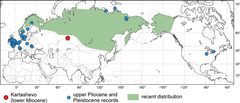
Helophorus sibiricus is a water scavenger beetle notable for its exceptional longevity as a . Fossil specimens from the Early Miocene (16-23 million years ago) of western Siberia have been reliably assigned to this extant species, making it one of the longest-documented living insect species. It inhabits standing waters across a broad Holarctic range.
Pronunciation
How to pronounce Helophorus sibiricus: /hɛˈlɒfərəs sɪˈbɪrɪkəs/
These audio files are automatically generated. While they are not always 100% accurate, they are a good starting point.
Identification
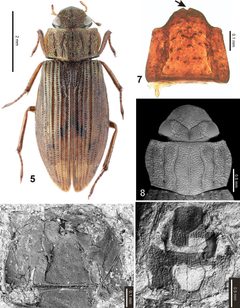
Reliable identification of fossil specimens has been achieved through -specific granulation patterns on the pronotum, which are preserved in sufficient detail to allow comparison with living . Male genitalia, typically used for species-level identification in this , are not preserved in the known fossil material.
Images
Habitat
Inhabits various kinds of standing waters, predominantly grassy temporary pools. The fossil discovery suggests that such temporary pool environments may represent stable over geological timescales.
Distribution
Holarctic distribution encompassing Northern Europe (Finland, Norway, Sweden), Northern Asia (Russia including Siberia, Japan, Mongolia, China), and North America (Alaska, Canada, USA). Fossil occurrences documented from Early Miocene deposits of the Irtysh River in western Siberia and Pleistocene deposits in Germany and Ukraine.
Life Cycle
Larvae remain unknown for this . Larvae of are typically terrestrial and , preying on various .
More Details
Evolutionary significance
The 16-23 million year temporal range of H. sibiricus challenges earlier estimates that insect persist on average only 2-3 million years. This species provides key evidence that some insects can survive major climatic changes over extended geological periods.
Fossil identification methodology
The fossil was identified despite absence of preserved genitalia because Helophorus beetles possess -specific pronotal granulation patterns that are diagnostic at the species level and were visible in the fossil specimen.