
Lucidota atra
(G. Olivier, 1790)
black firefly, woodland lucy
Lucidota atra is a diurnal firefly in the Lampyridae, native to eastern North America. Unlike most fireflies, are active during daylight hours and lack functional light organs. Males locate females using -sensing rather than bioluminescent signals. The species completes its in moist woodland , with bioluminescent larvae preying on soft-bodied .
Pronunciation
How to pronounce Lucidota atra: //luːˈsɪdoʊtə ˈeɪtrə//
These audio files are automatically generated. While they are not always 100% accurate, they are a good starting point.
Identification
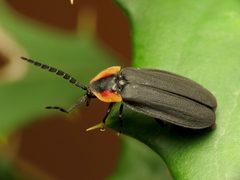
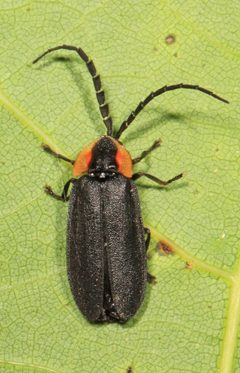
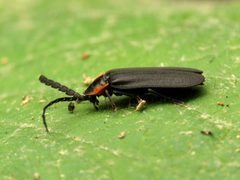
Distinguished from fireflies by activity, reduced , and lack of functional . The pronotal color pattern (red and yellow with medial black marking) separates it from uniformly dark firefly . Males are identifiable by their enlarged serrate , which are used to detect female . The granulated elytral texture differs from the smoother of some .
Images
Appearance
measure 9–12 mm in body length. The pronotum extends over the and is typically red and yellow with a medial black stripe or patch, though some individuals appear dark overall. are black or brown-black with a granulated texture. are segmented, conspicuous, black, and serrate; males possess larger antennae than females. are smaller than those of firefly . The adult light organ is greatly reduced and difficult to discern. Larvae are bioluminescent.
Habitat
Found primarily in open forest and shady open areas. Larvae inhabit moist environments, especially decaying wood. fly through forests at low heights (0.3–1.8 m above ground).
Distribution
Eastern North America, ranging west to Kansas, Nebraska, Oklahoma, and Texas, and south to Mexico. Also recorded in Central America.
Seasonality
emerge in early to midsummer. In eastern Canada, larvae eclose beginning late May, with adult numbers peaking late June to mid-July. In the southern Appalachians, numbers peak mid- to late June.
Diet
Larvae prey on soft-bodied such as snails and slugs. diet is not explicitly documented.
Life Cycle
Females lay that hatch in 2–3 weeks. Flightless larvae live in moist environments and prey on . Advanced larvae or pupae overwinter, with emerging the following early to midsummer.
Behavior
activity distinguishes this from most fireflies. Males fly low through forests in late morning to early afternoon, seeking females perched on low vegetation. Males identify mates by sensing female with their . Both sexes are capable of flight.
Ecological Role
Larvae function as of soft-bodied in moist woodland detritus. The serves as a food source for various predators, though specific documentation is limited.
Human Relevance
Serves as an example of diurnal firefly for educational and research purposes. Not known to be a pest .
Similar Taxa
- Photinus pyralis firefly with larger and functional bioluminescent signaling; active at night rather than during daylight hours.
- Other Lucidota speciesMay share pronotal color patterns but differ in activity period, antennal structure, or geographic range; precise distinctions require examination of male genitalia or molecular data.
More Details
Sensory Biology
L. atra expresses a characteristic set of odorant receptor genes in the , enabling -based mate location in the absence of visual signals.
Bioluminescence
possess pale terminal abdominal segments but no working lanterns; only larvae produce light.
Sources and further reading
- BugGuide
- Wikipedia
- GBIF taxonomy match
- iNaturalist taxon
- NCBI Taxonomy
- Catalogue of Life
- What a Wasp! What a Tattoo! | Bug Squad
- Bug Eric: Caught on Video: Prionyx atratus
- T.G.I.Flyday—Black horse fly (Tabanus atratus) | Beetles In The Bush
- Three new species of ground snakes discovered under graveyards and churches in Ecuador
- Lymexylidae | Beetles In The Bush
- Multiple Megarhyssa males | Beetles In The Bush