
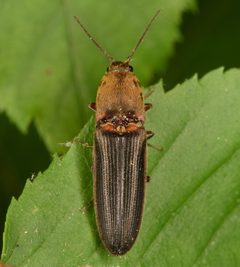
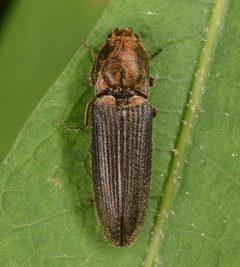
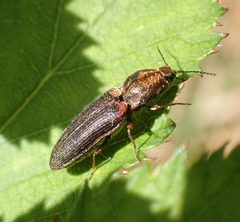
Limonius auripilis
(Say, 1823)
Red-Shouldered Wireworm
Limonius auripilis is a of click beetle in the Elateridae, commonly known as the Red-Shouldered . The larval stage, referred to as wireworms, are soil-dwelling pests known to damage agricultural crops. The species has been documented in Ontario and Québec, Canada. Research has examined -based trapping methods for monitoring and managing this and related Limonius species.
Pronunciation
How to pronounce Limonius auripilis: /lɪˈmoʊ.ni.əs ɔːˈrɪ.pɪlɪs/
These audio files are automatically generated. While they are not always 100% accurate, they are a good starting point.
Identification
Distinguished from other Limonius by specific morphological features; are click beetles with the 's characteristic body form allowing for the clicking/jumping mechanism. Larvae are elongated, cylindrical, and hard-bodied (wireworms), typical of Elateridae. Specific diagnostic characters for separating L. auripilis from such as L. agonus, L. canus, and L. infuscatus require detailed examination.
Images
Habitat
Agricultural fields and associated soil environments; distribution records indicate presence in Ontario and Québec, Canada.
Distribution
Canada: Ontario and Québec.
Life Cycle
Complete with , larval (), pupal, and stages. Larval stage is prolonged and soil-dwelling.
Ecological Role
Larvae function as soil-dwelling herbivores/; are not known to be economically damaging.
Human Relevance
Similar Taxa
- Limonius agonusCongeneric with overlapping distribution; distinguished by morphological examination
- Limonius canusCongeneric ; and larvae similar in general form, requiring detailed identification
- Limonius infuscatusCongeneric within the same ; separation requires identification