
Limonius canus
LeConte, 1853
Pacific Coast Wireworm
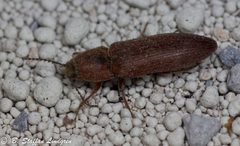
Limonius canus, commonly known as the Pacific Coast , is a click beetle in the Elateridae. The larval stage is a significant agricultural pest, particularly damaging to potatoes, wheat, and other crops in the Pacific Coast region of North America. Research has documented its behavioral responses to , including repellence and contact-induced morbidity from certain compounds. The species harbors diverse gut bacteria that have been investigated for potential biocontrol applications.
Pronunciation
How to pronounce Limonius canus: /lɪˈmoʊ.ni.əs ˈkeɪ.nəs/
These audio files are automatically generated. While they are not always 100% accurate, they are a good starting point.
Images
Habitat
Soil in agricultural fields, particularly potato-growing regions and wheat areas.
Distribution
Pacific Coast region of North America. Documented from Oregon and Washington, USA, and British Columbia, Alberta, and Saskatchewan, Canada.
Diet
Germinated wheat seeds and potato tubers. The is described as a serious pest of potato and has been documented feeding on wheat seeds in laboratory .
Host Associations
- Solanum tuberosum - pestSerious pest of potato crops
- Triticum aestivum - pestDocumented feeding on germinated wheat seeds in ; described as pest of wheat
Life Cycle
Larval stage is the primary feeding and damaging stage. Larvae are soil-dwelling and can survive extended periods of morbidity (exceeding 150 days) with recovery observed within 21 days for most individuals.
Behavior
Larvae exhibit sublethal behavioral responses to certain : repelled by tefluthrin-treated seeds after brief contact (<20 min), showing contact-induced morbidity from which most recover. Does not demonstrate aversion learning or behavioral modification upon repeated contact. High mortality and poor recovery observed following exposure to thiamethoxam (Cruiser) at higher application rates.
Ecological Role
Agricultural pest causing damage to root crops and germinating seeds. Potential for gut bacteria that may be modified for biocontrol purposes.
Human Relevance
Significant agricultural pest requiring management in potato and wheat production. Subject of research on efficacy, including behavioral assays showing that repellence and morbidity complicate control assessments. Investigated as a target for biocontrol through manipulation of associated gut bacteria.
Similar Taxa
- Agriotes obscurusDusky wireworm; compared directly in studies showing differential responses to treatments, with L. canus showing higher mortality to thiamethoxam and different recovery patterns
- Melanotus communisCornfield ; related wireworm in same with similar agricultural pest status and
- Other Limonius speciesCongeneric wireworms; synthetic studies indicate multiple Limonius spp. occur across North America and may be captured in similar monitoring traps
Sources and further reading
- BugGuide
- Wikipedia
- GBIF taxonomy match
- iNaturalist taxon
- NCBI Taxonomy
- Grasshopper Collections and Survey
- Entomology 2020: Attendees Share Early Reactions to On-Demand Presentations, Posters
- Gut bacteria associated with the Pacific Coast wireworm,Limonius canus, inferred from 16s rDNA sequences and their implications for control
- Response of the Pacific Coast wireworm, Limonius canus, and the dusky wireworm, Agriotes obscurus (Coleoptera: Elateridae), to insecticide-treated wheat seeds in a soil bioassay