
Podabrus
Dejean, 1833
soldier beetle, leatherwing
Species Guides
34- Podabrus appendiculatus
- Podabrus basillaris(soldier beetle)
- Podabrus binotatus(soldier beetle)
- Podabrus brevicollis(Short-collared Soldier Beetle)
- Podabrus brimleyi(soldier beetle)
- Podabrus brunnicollis(soldier beetle)
- Podabrus cascadensis
- Podabrus conspiratus(soldier beetle)
- Podabrus diadema(soldier beetle)
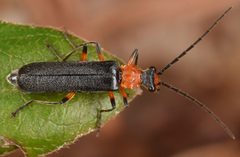
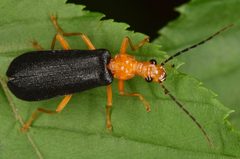
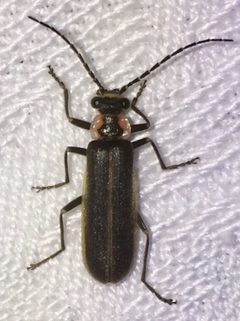
Podabrus is a of soldier beetles ( Cantharidae) containing over 100 described distributed across Europe, North America, and Asia. are commonly found on flowers and foliage, where they feed on soft-bodied insects such as aphids. The genus is recognized by the characteristic soldier beetle : elongate bodies with soft, flexible , and typically dark coloration with orange, red, or yellow markings. Species in this genus contribute to of pest insects in gardens and agricultural settings.
Pronunciation
How to pronounce Podabrus: //pəʊˈdæb.rəs//
These audio files are automatically generated. While they are not always 100% accurate, they are a good starting point.
Identification
Podabrus are distinguished from other soldier beetle by the combination of 11-segmented, threadlike held forward of the body; pronotum wider than the and wider than long; and soft, flexible, smooth to velvety . The head is commonly bent downward. Coloration is typically dark brown to black with orange, red, or yellow markings. Body length ranges from approximately 1.5 to 28 mm, varying by species. These traits separate Podabrus from common sympatric genera such as Cantharis and Chauliognathus, which may differ in pronotum proportions, antennal structure, or color pattern.
Images
Habitat
Open woodland , particularly areas with pine trees (Pinaceae); upland habitats across Europe; larvae occur in upper soil layers and organic debris. frequently observed on flowers, especially umbellifers, and on leaves infested with aphids or other honeydew-excreting insects.
Distribution
Europe, North America, and Asia. In Europe, widespread across the northern Palearctic from western Europe to East Asia; common throughout much of the United Kingdom except the east and south-west of England. In North America, present across temperate regions with recorded in California and other areas.
Seasonality
active from mid-May through August. Activity peaks during warmer daylight hours, with adults becoming more dispersed in late afternoons and evenings.
Diet
are of soft-bodied insects, particularly aphids. Adults have been observed feeding on pollen. Larvae are believed to be predatory, though this is less well documented.
Life Cycle
Larvae inhabit upper soil layers and organic debris. are the primary active stage observed above ground. Specific details on deposition, , and larval development duration are not well documented in available sources.
Behavior
are and frequently rest on umbellifer flowers during warm weather. When disturbed, adults may withdraw their legs and drop to the ground in a death-feigning response. Adults possess chemical defense glands that excrete noxious, defensive compounds; the blackish and red coloration serves as aposematic warning to vertebrate . Members of this participate in extensive mimicry rings.
Ecological Role
of soft-bodied insects, contributing to of agricultural and garden pests such as aphids.
Human Relevance
Beneficial insects in gardens and agricultural systems due to on aphids and other pest . Occasionally referenced in educational and outreach contexts by entomology programs.
Similar Taxa
- CantharisBoth are common soldier beetle in the same ; Cantharis may differ in pronotum proportions and specific color patterns.
- ChauliognathusAnother common sympatric soldier beetle ; Chauliognathus often differ in antennal structure and body proportions.