
Podabrus basillaris
soldier beetle, leatherwing
Podabrus basillaris is a soldier beetle in the Cantharidae, commonly found in California. are of aphids and other soft-bodied insects, frequently observed on flowers and foliage. The exhibits defensive including (playing dead) when disturbed and chemical secretion from abdominal glands. Its black and red coloration serves as aposematic warning to vertebrate predators.
Pronunciation
How to pronounce Podabrus basillaris: //pəˈdeɪbrəs ˈbæsɪˌlɛərɪs//
These audio files are automatically generated. While they are not always 100% accurate, they are a good starting point.
Identification
Distinguished from other California soldier beetles by -level traits: Podabrus can be separated from Cantharis and Chauliognathus by specific morphological characters, though precise species-level identification of P. basillaris requires examination of detailed structural features. The combination of black base color with red/orange markings, 11-segmented , and soft confirms membership in Cantharidae. Final determination to species typically requires examination.
Images
Appearance
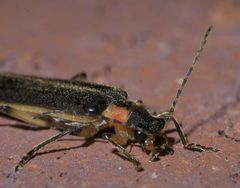
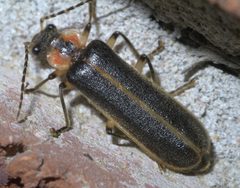
are elongate beetles with soft, flexible wing covers () that appear smooth to velvety. The is commonly bent downward. are 11-segmented, threadlike, and typically held forward of the body. The pronotum is wider than the head and wider than long. Coloration includes black with orange, red, or yellow markings. Body length ranges within the typical soldier beetle size of 1/16 to 1-1/8 inches (1.5 to 28 mm).
Habitat
are found on flowers and leaves, particularly those infested with aphids or other honeydew-excreting insects. Gardens, agricultural settings, and natural vegetation with flowering plants support adult . Specific microhabitat preferences for larvae remain undocumented in available sources.
Distribution
Documented in California, USA. The Podabrus is listed among common soldier beetle genera occurring in the state, with approximately 160 Cantharidae in 11 genera recorded statewide. Precise range boundaries within California are not specified in available literature.
Seasonality
are active during the day. Specific seasonal activity patterns for P. basillaris are not documented; general Cantharidae activity in California extends through the growing season when prey (aphids) and flowers are available.
Diet
are predatory, feeding on aphids and other soft-bodied insects. They have been observed consuming aphids on rose bushes and strawberry plants. Larval diet is not specified in available sources.
Life Cycle
Complete with , larva, pupa, and stages. Larval and developmental duration are not documented for this . Adults are the most frequently observed life stage.
Behavior
When disturbed, withdraw their legs and drop to the ground in (feigning death). Adults, larvae, and pupae can excrete noxious defensive chemicals from specialized abdominal glands. Adults are and actively forage on vegetation. They fly between plants when searching for prey or mates.
Ecological Role
of aphids and other soft-bodied insects, contributing to of pest in gardens and agricultural systems. Defensive chemistry and aposematic coloration indicate a role in predator-prey chemical .
Human Relevance
Beneficial insect in gardens and agriculture due to . Used as subject for educational outreach, including a jack o'lantern carving depicting a soldier beetle displayed at the Bohart Museum of Entomology, UC Davis. No documented negative impacts.
Similar Taxa
- Cantharis spp.Other common California soldier beetle ; requires examination of pronotum shape and other structural characters for separation from Podabrus.
- Chauliognathus spp.Another common California soldier beetle ; often larger and with different color patterns, but precise identification requires knowledge.
- Coccinellidae (lady beetles)Also with warning coloration, but have hard, convex rather than soft flexible ones, and typically shorter .
More Details
Defensive Chemistry
, larvae, and pupae possess specialized abdominal glands capable of excreting noxious defensive compounds, making them distasteful to vertebrate . This chemical defense is advertised through conspicuous black and red coloration.