
Pseudohylesinus
Eggers, H., 1920
Species Guides
7- Pseudohylesinus grandis
- Pseudohylesinus granulatus(Fir Root Bark Beetle)
- Pseudohylesinus maculosus
- Pseudohylesinus nebulosus(Douglas-fir pole beetle)
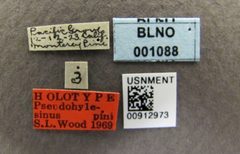
- Pseudohylesinus pini
- Pseudohylesinus sericeus(silver fir beetle)
- Pseudohylesinus tsugae
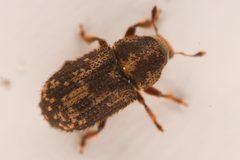
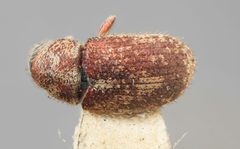
Pseudohylesinus is a of crenulate bark beetles ( Curculionidae) comprising at least 20 described . Members are small, slender beetles (approximately 2.8 mm length) associated with coniferous trees in western North America. The genus includes economically notable species such as the Douglas-fir hylesinus (P. nebulosus), which attacks Douglas-fir and related . Species in this genus exhibit distinctive reproductive including acoustic signaling and primary attraction to host volatiles rather than -mediated .
Pronunciation
How to pronounce Pseudohylesinus: //ˌsʊːdoʊˌhaɪlɪˈsaɪnəs//
These audio files are automatically generated. While they are not always 100% accurate, they are a good starting point.
Images
Habitat
Coniferous forests of western North America, primarily associated with trees in the Pseudotsuga, Tsuga, Abies, Thuja, and Pinus. utilize standing live trees, fresh slash, or stumps depending on the species.
Distribution
Western North America, from British Columbia to Mexico. Specific distributions vary; P. nebulosus ranges throughout this entire region, while P. tsugae and P. grandis are documented from coastal stands of western hemlock.
Diet
Phloem of coniferous trees. females of some feed in the inner-bark region of standing live trees prior to initiating galleries.
Host Associations
- Pseudotsuga menziesii - primary preferred for P. nebulosus
- Thuja plicata - recorded for P. nebulosus on west coast of British Columbia
- Abies grandis - recorded for P. nebulosus
- Abies amabilis - recorded for P. nebulosus on west coast of British Columbia
- Tsuga heterophylla - recorded for P. nebulosus and primary for P. tsugae and P. grandis
- Pinus ponderosa - recorded for P. nebulosus in interior British Columbia
Life Cycle
Some have one per year with two and four larval instars. P. grandis typically overwinters as a ; P. tsugae overwinters as a fourth instar larva.
Behavior
Mature males stridulate, producing distinct chirps for stress, attraction, and rivalry contexts. Males are strongly arrested by female and defend galleries against intruding males. occurs through primary attraction to tree volatiles rather than -mediated secondary attraction. Reproductively males lack territorial and produce only distinguishable stress chirps.
Ecological Role
Bark beetles that contribute to tree mortality and forest disturbance dynamics. Some preferentially colonize fresh stumps or slash in thinned stands, potentially influencing post-harvest forest .
Human Relevance
Some attack economically important timber species including Douglas-fir. The has been studied for its unusual mechanism lacking -mediated secondary attraction, which distinguishes it from many other scolytine bark beetles.
Similar Taxa
- Other Scolytinae bark beetlesPseudohylesinus lack -mediated secondary , relying instead on primary attraction to volatiles—a distinctive behavioral difference from many congeneric bark beetles.
More Details
Reproductive maturation
reproductive maturation in P. nebulosus involves development of close-range olfactory sensitivity to female , acquisition of territorial , and differentiation of acoustic signals. males cannot produce attraction or rivalry chirps and do not defend galleries.
Taxonomic note
The was historically placed in , now treated as Scolytinae within Curculionidae. are described as 'crenulate bark beetles' referring to features of the elytral declivity.
Sources and further reading
- BugGuide
- Wikipedia
- GBIF taxonomy match
- iNaturalist taxon
- NCBI Taxonomy
- Catalogue of Life
- Pseudohylesinus nebulosus (LeConte) (Col., Scolytidae): aggregation by primary attraction
- OLFACTORY AND ACOUSTIC BEHAVIOR OFPSEUDOHYLESINUS NEBULOSUS(COLEOPTERA: SCOLYTIDAE) ON DOUGLAS-FIR BARK
- Life History and Habits of Pseudohylesinus nebulosus (Leconte) (Coleoptera: Scolytidae) in the Interior of British Columbia
- THE BIOLOGIES OF PSEUDOHYLESINUS TSUGAE AND P. GRANDIS (COLEOPTERA: SCOLYTIDAE) IN WESTERN HEMLOCK