
Hylastinus obscurus
(Marsham, 1802)
Clover Root Borer, Clover Root Rot
Hylastinus obscurus is a scolytine bark beetle native to the Palearctic region that has become a significant agricultural pest in introduced ranges. The develops in the roots of leguminous plants, particularly red clover (Trifolium pratense), where larvae create distinctive hook-shaped galleries. are active during warm midday conditions and respond to host-derived volatile compounds for host location. In Chile and parts of North America, it is considered the primary cause of red clover decline, often in association with fungal .
Pronunciation
How to pronounce Hylastinus obscurus: /hɪˈlæstɪnəs əbˈskjʊərəs/
These audio files are automatically generated. While they are not always 100% accurate, they are a good starting point.
Identification
Distinguished from other Hylastinus by association with root-feeding habit on Trifolium pratense; antennal configuration (four types in club, one in scape/funicle) may aid identification. Larval galleries in roots are short (0.5–2.5 cm), single or branched, and described as hook-shaped. Confirmation requires examination of genitalia or molecular methods.
Images
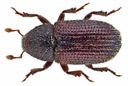
Appearance
Small bark beetle with typical scolytine : compact, cylindrical body form. terminate in a club bearing four types (chaetica, basiconica, trichoidea, styloconica), with chaetica and basiconica comprising approximately 80% of club sensilla. No in antennal sensilla configuration.
Habitat
Green areas, meadows, and agricultural fields with scattered trees and shrubs; specifically elevated meadow areas dominated by Trifolium pratense growing in clumps among grasses. In agricultural settings, infests red clover stands during second and third years of growth.
Distribution
Native to Palearctic Europe, North Africa (Algeria, Morocco), Madeira, and Canary Islands. Introduced to North America (Canada, USA) and South America (Chile). In Poland: scattered historical records from Trzebnica Hills, Western and Eastern Beskids, Mazovian Lowland, Sandomierz Lowland; post-war records from Masurian Lake District and Wielkopolska-Kujawy Lowland; recent records from Warsaw-Ursynów, Wrocław, and Lesser Poland Upland. In Quebec: throughout western, southern, and central regions.
Seasonality
active during warm sunny midday hours (12–14 h) at approximately 20°C. Swarming period observed in late April to early May in Poland. Spring activity documented in Quebec; very few plants surviving a second winter show the following spring.
Diet
Larvae develop in roots of plants, mining root tissue to create galleries. feed on root tissue.
Host Associations
- Trifolium pratense - Primary ; roots attacked by larvae
- Trifolium spp. - Additional clover
- Melilotus spp. - Rare Sweet clovers
- Medicago spp. - Rare Medics
- Cytisus spp. - Rare Brooms
- Onobrychis spp. - Rare Sainfoin
- Ulex europaeus - Sporadic Gorse
- Sarothamnus scoparius - Sporadic Broom
- Ononis spp. - Sporadic Restharrow
Life Cycle
Larval development occurs in plant roots. have been isolated from 2-year-old red clover roots. Specific details on number of , stage, and complete duration remain undocumented for most .
Behavior
spread from point of origin during brief spring . Attracted to volatiles from 1.5-year-old red clover roots; E-2-hexenal is attractive, limonene is repellent. Also attracted to long-chain in roots of 9-month-old clover plants. Attracted to roots diseased by fungi (Colletotrichum trifolii, Fusarium roseum, F. tricinctum, Rhizoctonia solani) more than healthy roots. Uses olfactory system for finding food, nesting, mating, and identifying conspecifics.
Ecological Role
Considered a pest of red clover crops in the USA and Chile, where it is the main cause of red clover decline. Associated with fungal that weaken and kill plants; activity may help initiate fungal . include cantharid larvae, staphylinid beetles (Grohypnus sp.), and unidentified dipterous larvae.
Human Relevance
Major agricultural pest in red clover production regions. Lindane application in spring has been shown to increase clover hay yields on artificially infested plots. Plant secondary metabolites from Pilgerodendron uviferum heartwood (sesquiterpenes including (−)-trans-calamenene, cadalene, and (−)-torreyol) demonstrate antifeedant effects and are being investigated as alternative control agents.
Similar Taxa
- Other ScolytinaeHylastinus obscurus is distinguished by its specific association with leguminous root , particularly Trifolium pratense, and its hook-shaped larval galleries in root tissue rather than phloem or wood.
More Details
Chemical Ecology
Antennal configuration (chaetica, basiconica, trichoidea, styloconica) suggests chemoreceptive (olfactory/), mechanoreceptive, and hygro/thermoreceptive functions. Field and laboratory studies demonstrate specific behavioral and electrophysiological responses to -derived .
Pest Status Variation
While a major pest in Chile and parts of North America, the is rarely observed in parts of its native European range (e.g., Poland), where historically only single individuals were recorded until 2023.
Sources and further reading
- BugGuide
- Wikipedia
- GBIF taxonomy match
- iNaturalist taxon
- NCBI Taxonomy
- Catalogue of Life
- Aphytis Project Final Report | Entomology Research Museum
- Bug Eric: Year-end Wrap-up
- The “obscure” Dicerca | Beetles In The Bush
- Hylastinus obscurus (Marsham, 1802) (Coleoptera: Curculionidae) in Poland – occurrence and comments on biology
- Behavioral and electrophysiological responses of Hylastinus obscurus to volatiles released from the roots of Trifolium pratense L.
- Type and Distribution of Sensilla in the Antennae of the Red Clover Root Borer,Hylastinus obscurus
- THE DISTRIBUTION AND IMPORTANCE OF THE CLOVER ROOT BORER (HYLASTINUS OBSCURUS (MARSH) COLEOPTERA: SCOLYTIDAE) IN QUEBEC
- Field response of Hylastinus obscurus Marsham (Coleoptera: Curculionidae) to E-2-hexenal and limonene, two host-derived semiochemicals
- Identification of volatiles from differently aged red clover (Trifolium pratense) root extracts and behavioural responses of clover root borer (Hylastinus obscurus) (Marsham) (Coleoptera: Scolytidae) to them
- Antifeedant Effects of Essential Oil, Extracts, and Isolated Sesquiterpenes from Pilgerodendron uviferum (D. Don) Florin Heartwood on Red Clover Borer Hylastinus obscurus (Coleoptera: Curculionidae)