
Hylastinus
Bedel, 1888
clover root borer (for H. obscurus)
Species Guides
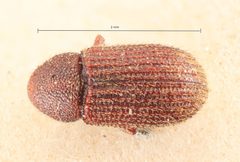
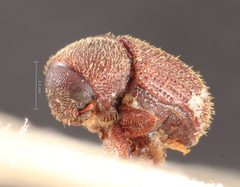
1- Hylastinus obscurus(Clover Root Borer)
A of crenulate bark beetles (Curculionidae: Scolytinae) comprising approximately 11 described . The genus is best known through Hylastinus obscurus, the clover root borer, which has been extensively studied due to its status as a major agricultural pest of red clover (Trifolium pratense). Members develop in roots of leguminous plants, with larvae creating short galleries in root tissues. The genus has a Palearctic native distribution but H. obscurus has been introduced to North and South America where it causes significant crop damage.

Pronunciation
How to pronounce Hylastinus: /hɪˈlæstɪnəs/
These audio files are automatically generated. While they are not always 100% accurate, they are a good starting point.
Images
Habitat
Associated with leguminous plants, particularly in meadows, pastures, and agricultural settings where clover and related crops grow. Hylastinus obscurus specifically inhabits the root zone of red clover and other Fabaceae, with larvae tunneling within root tissues and active in soil surface layers and vegetation during swarming periods.
Distribution
Native to the Palearctic: Europe (including Poland, Czech Republic, Germany), North Africa (Algeria, Morocco), and Atlantic islands (Madeira, Canary Islands). Introduced to North America (Canada, USA including Vermont) and South America (Chile), where H. obscurus has established as an pest. GBIF records indicate presence in Denmark, Norway, and Sweden.
Seasonality
of H. obscurus observed swarming in late April in Poland (23 April – 1 May 2023), with activity during warm sunny midday conditions (12–14h, ~20°C). Spring period for documented in Quebec. Specific seasonality for other unknown.
Diet
Phytophagous: larvae develop in roots of leguminous plants. Hylastinus obscurus primarily feeds on Trifolium pratense (red clover); additional include other Trifolium , Melilotus, Medicago, Cytisus, Onobrychis, and rarely Ulex, Sarothamnus, or Ononis. Diet of other Hylastinus species unknown.
Host Associations
- Trifolium pratense - primary (larval development, feeding)red clover; main for H. obscurus
- Trifolium spp. - larval multiple clover
- Melilotus spp. - occasional larval sweet clover; rare
- Medicago spp. - occasional larval alfalfa/lucerne; rare
- Cytisus spp. - occasional larval broom; rare
- Onobrychis spp. - occasional larval sainfoin; rare
- Colletotrichum trifolii - associated microorganismfungal of roots attracts
- Fusarium spp. - associated microorganismincluding F. roseum, F. tricinctum; attracts to infected roots
- Rhizoctonia solani - associated microorganismattracts to infected roots
Life Cycle
Larvae create short galleries (0.5–2.5 cm) in roots, described as somewhat hook-shaped, single or branched. disperse via brief spring . location, number of per year, and complete developmental timeline unknown; H. obscurus infests second- and third-year red clover stands. and -laying details not documented.
Behavior
exhibit aggregated swarming ; 53 individuals collected over 9 days in Warsaw. Active during warm, sunny midday conditions. Olfactory-driven location: attracted to root volatiles including E-2-hexenal from 1.5-year-old red clover roots, and to long-chain in roots of younger plants. Repelled by limonene. Adults attracted to roots infected by fungi (Colletotrichum trifolii, Fusarium spp., Rhizoctonia solani). Brief spring for from points.
Ecological Role
Root herbivore of leguminous plants. Hylastinus obscurus is a significant pest of red clover in agricultural systems, contributing to crop decline and stand failure. feeding activity may facilitate entry of fungal into root tissues, potentially accelerating plant mortality. In native range, likely functions as a natural herbivore of wild legume at low densities.
Human Relevance
Hylastinus obscurus is an economically important pest of red clover forage crops in North America (USA, Canada) and Chile, where it has been introduced. rates of 28–94% recorded in Quebec red clover stands. Considered a primary cause of red clover decline in Chile. Lindane (historically) and plant-derived compounds (sesquiterpenes from Pilgerodendron uviferum) investigated for control. Antennal studied for potential -based management approaches.
Sources and further reading
- BugGuide
- Wikipedia
- GBIF taxonomy match
- iNaturalist taxon
- NCBI Taxonomy
- Catalogue of Life
- Hylastinus obscurus (Marsham, 1802) (Coleoptera: Curculionidae) in Poland – occurrence and comments on biology
- Type and Distribution of Sensilla in the Antennae of the Red Clover Root Borer,Hylastinus obscurus
- Behavioral and electrophysiological responses of Hylastinus obscurus to volatiles released from the roots of Trifolium pratense L.
- THE DISTRIBUTION AND IMPORTANCE OF THE CLOVER ROOT BORER (HYLASTINUS OBSCURUS (MARSH) COLEOPTERA: SCOLYTIDAE) IN QUEBEC
- Field response of Hylastinus obscurus Marsham (Coleoptera: Curculionidae) to E-2-hexenal and limonene, two host-derived semiochemicals
- Identification of volatiles from differently aged red clover (Trifolium pratense) root extracts and behavioural responses of clover root borer (Hylastinus obscurus) (Marsham) (Coleoptera: Scolytidae) to them
- Antifeedant Effects of Essential Oil, Extracts, and Isolated Sesquiterpenes from Pilgerodendron uviferum (D. Don) Florin Heartwood on Red Clover Borer Hylastinus obscurus (Coleoptera: Curculionidae)