
Pachylobius picivorus
(Germar, 1823)
pitch-eating weevil, pitch eating weevil
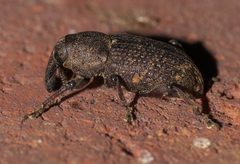
Pachylobius picivorus, commonly known as the pitch-eating weevil, is a pine root-feeding weevil native to North America. The is an economically significant pest of natural and planted pine seedlings, with development requiring 100–128 days during summer. are long-lived and oviposit continuously at approximately 0.7 per day per female throughout their lifespan. exhibit two peaks in the Georgia Piedmont, driven by temperature and developmental cycles. Behavioral studies indicate the species responds strongly to olfactory cues, particularly ethanol and turpentine mixtures, though visual cues are less important for location than in related species such as Hylobius pales.
Pronunciation
How to pronounce Pachylobius picivorus: //ˌpækɪˈloʊbiəs ˌpɪsɪˈvɔːrəs//
These audio files are automatically generated. While they are not always 100% accurate, they are a good starting point.
Identification
Pachylobius picivorus can be distinguished from the closely related Hylobius pales (pales weevil) by behavioral differences in trap response: P. picivorus lands at greater distances from odor sources and walks toward them, whereas H. pales exhibits more directed to point sources. Morphological separation from other Pachylobius and pine weevils requires examination of rostral proportions, antennal insertion, and body punctation; specific diagnostic characters should be confirmed with taxonomic keys.
Images
Habitat
Associated with pine sites, including natural stands and planted pine seedling nurseries. In the Georgia Piedmont, are tied to areas with pine seedling establishment. The is ground-dwelling and root-feeding in the larval stage.
Distribution
North America, with confirmed records from the Georgia Piedmont (eastern United States), Ontario and Labrador (Canada), and referenced occurrence in east Texas. Distribution corresponds with native and planted Pinus ranges.
Seasonality
Two peaks annually in the Georgia Piedmont, reflecting responses to temperature and developmental cycles. development occurs during summer months.
Diet
Larvae feed on roots of pine seedlings. Specific feeding habits are not documented in available sources.
Host Associations
- Pinus - larval natural and planted pine seedlings; root tissue consumed
Life Cycle
development requires 100–128 days during summer. are long-lived with continuous oviposition throughout life at approximately 0.7 per day per female.
Behavior
Responds strongly to olfactory cues, particularly 5:1 ethanol:turpentine mixtures. More than 80% of individuals land at a distance from odor sources and walk toward them, contrasting with the more directed response of Hylobius pales. Visual cues are secondary to olfactory cues in -finding .
Ecological Role
Pest of pine seedling ; larval root feeding can damage or kill young pine trees, affecting forest establishment and plantation productivity.
Human Relevance
Economic pest of forestry operations, particularly affecting planted pine seedlings. Subject to monitoring using Tedders traps and modified Tilles traps with ethanol-turpentine lures. Trap capture is lower than for Hylobius pales due to the ' dispersed landing .
Similar Taxa
- Hylobius palesCo-occurring pine root weevil with similar and associations; distinguished by more directed response to traps and odor sources, and higher trap capture
- PachylobiusCongeneric with overlapping ranges; require morphological examination for definitive identification
More Details
Trap response characteristics
In behavioral studies using Tedders traps, P. picivorus exhibited an 18% capture rate compared to >70% for Hylobius pales, reflecting its tendency to land away from traps and approach on foot. This has implications for monitoring and management strategies.
Sources and further reading
- BugGuide
- Wikipedia
- GBIF taxonomy match
- iNaturalist taxon
- NCBI Taxonomy
- Catalogue of Life
- BIOLOGY OF PACHYLOBIUS PICIVORUS (COLEOPTERA: CURCULIONIDAE) IN THE GEORGIA PIEDMONT
- Behavioral Response by Hylobius pales, Pachylobius picivorus (Coleoptera: Curculionidae) and Xylotrechus sagittatus (Coleoptera: Cerambycidae) to Trap Visual and Olfactory Cues and an Estimate of Trap Efficiency