
Hylobius pales
Boheman, 1834
Pales Weevil
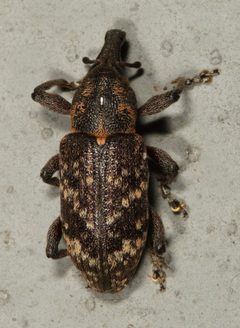
Hylobius pales, commonly known as the pales weevil, is a significant forest pest in North America that primarily attacks coniferous trees, especially of Pinus. are dark red-brown with yellowish or gray hair tufts on the and , and possess a robust, cylindrical, gently curved rostrum nearly as long as the thorax. The species is particularly damaging to young pine seedlings in cut-over areas and Christmas tree plantations, with mortality rates reaching 30-70% in unprotected plantings. Larvae develop in stumps and roots of trees, while adults feed on bark.
Pronunciation
How to pronounce Hylobius pales: //hɪˈloʊbiəs ˈpeɪliːz//
These audio files are automatically generated. While they are not always 100% accurate, they are a good starting point.
Identification
Distinguished from similar weevils by the combination of dark red-brown coloration with contrasting yellowish or gray hair tufts, the robust and nearly straight cylindrical rostrum, and antennal placement before the middle of the rostrum. The 5:1 ethanol-turpentine blend used in trapping studies is highly specific for monitoring this . Distinguished from Pachylobius picivorus by stronger directed response to odor point sources and greater visual cue importance in -finding .
Images
Appearance
are dark red-brown in color with tufts of yellowish or gray hairs punctuating the and . The rostrum is robust, cylindrical, gently curved, and nearly as long as the thorax. are located before the middle of the rostrum, positioned close to the sides of the mouth. Body length ranges from 5.8 to 11.3 mm.
Habitat
Coniferous forest environments, particularly cut-over areas with fresh stumps where breeding occurs. Found in Christmas tree plantations, white pine areas, and pine forests. congregate near fresh stumps in spring and move to nearby trees in summer. Daytime resting sites are beneath trees; climbing on trees for feeding.
Distribution
Eastern North America from Nova Scotia to Manitoba in Canada, throughout the eastern United States east of the Mississippi River and north of Florida, extending south to Puerto Rico. Present in Alabama, Arkansas, Connecticut, District of Columbia, Florida, Georgia, Illinois, Indiana, Kentucky, Louisiana, Maine, Maryland, Massachusetts, Michigan, Minnesota, Mississippi, Missouri, New Hampshire, New Jersey, New York, North Carolina, Ohio, Oklahoma, Pennsylvania, Rhode Island, South Carolina, Texas, Vermont, Virginia, Washington, West Virginia, and Wisconsin. Also recorded in Alberta and British Columbia.
Seasonality
are active year-round with peaks influenced by temperature. In southern populations, two or more per year occur; northern populations typically have one generation with some adults for two years. Seasonal activity shows two population peaks annually in the Georgia Piedmont region. Spring congregation near fresh stumps followed by summer to nearby trees.
Diet
feed on bark of young conifer seedlings, particularly Pinus strobus (white pine) and other Pinus . Feeding is synergistically stimulated by sucrose combined with phloem lipid extracts. Larvae tunnel and feed on vascular tissues of tree stumps and roots.
Host Associations
- Pinus strobus - primary - feed on bark of seedlings, larvae develop in stumps and rootsEastern white pine, major economic
- Pinus taeda - - phloem extracts stimulate feedingLoblolly pine
- Pinus spp. - - general conifer associationVarious pine serve as
Life Cycle
are oviposited in stumps and roots of suitable plants. Larvae tunnel through and feed upon the tree's vascular tissues, progressing through five or six instars before pupating. occurs within the host material. emerge through the bark. Southern may complete two or more annually; northern populations typically complete one generation with extended adult longevity and some for two years.
Behavior
climbing : rest beneath trees during daylight hours and climb onto trees at night to feed. Adults are attracted to volatile compounds emanating from distressed and dying trees, including ethanol and turpentine in 5:1 ratio. Strong directed response to olfactory cues followed by visual cues in -finding hierarchy; more precise point-source orientation than Pachylobius picivorus. is slow within favorable ; marked individuals typically recaptured in original capture plots. Adults respond to bark beetle (frontalin, exo-brevicomin) and Ips calligraphus-infested bolts, likely as kairomonal exploitation of indicating suitable host resources.
Ecological Role
Major pest of coniferous forests, particularly limiting white pine regeneration in cut-over areas. Acts as for fungal including Leptographium procerum and Ophiostoma piceae, transmitting these blue-stain fungi to healthy trees during feeding. are strongly influenced by forest management practices, especially clear-cutting. Serves as for fungus Metarhizium anisopliae, which causes green muscardine .
Human Relevance
Significant economic pest in forestry and Christmas tree production. Can kill 30-70% of young pine seedlings in unprotected plantings during the first two years following clear-cutting. Management recommendations include avoiding white pine planting for two seasons after cutting, use of chemical sprays and dips, and with Metarhizium anisopliae. Trapping with ethanol-turpentine blends and freshly cut pine billets used for monitoring. Subject to regulations for interstate movement due to plant pest status.
Similar Taxa
- Pachylobius picivorusSimilar root-feeding weevil in same , but less visually oriented in -finding and shows weaker point-source orientation to olfactory cues; more than 80% land away from traps and walk toward them versus less than 30% for H. pales
- Hylobius abietisCongeneric pine weevil with similar ; global distribution analysis studies compare climatic suitability between these two economically important
- Pissodes nemorensisCo-occurring pine weevil sharing fungal associates (Leptographium procerum, Ophiostoma piceae) and similar in Christmas tree plantations
More Details
Kairomonal Response
Attraction to bark beetle (frontalin, exo-brevicomin) and Ips-infested bolts represents exploitation of from other that signal suitable resources
Trapping Efficiency
Tedders traps capture >70% of H. pales when baited with 5:1 ethanol-turpentine blend; elevated traps increase capture of associated cerambycids but not weevils
Fungal Vector Capability
Confirmed of Leptographium procerum and Ophiostoma piceae to eastern white pine; wounds from feeding provide entry points for these blue-stain fungi
Sources and further reading
- BugGuide
- Wikipedia
- GBIF taxonomy match
- iNaturalist taxon
- NCBI Taxonomy
- Catalogue of Life
- UC Davis Art/Science Fusion Program Offering Jos Sances' Screen-Printing Workshops | Bug Squad
- It Was a Scorpion Kind of Day at the Bohart Museum of Entomology | Bug Squad
- A non-black background is better… often! | Beetles In The Bush
- North America’s longest insect | Beetles In The Bush
- Entomologists Discuss Discovery's "Mosquito" Documentary: A Live-Tweet Recap
- 30-Year Study Documents Decline of Bioluminescent Beetles in Brazil
- Hylobius pales . [Distribution map].
- The Pales Weevil, Hylobius pales (Hbst.), in Southern Ontario
- Green muscardine disease of Hylobius pales (Herbst) (Coleoptera: Curculionidae)
- Some Light and Temperature Effects on the Behavior of the Adult Pales Weevil, Hylobius Pales (Coleoptera: Curculionidae)
- DISPERSION AND SEASONAL ACTIVITY OF THE PALES WEEVIL, HYLOBIUS PALES (COLEOPTERA: CURCULIONIDAE), IN MICHIGAN CHRISTMAS TREE PLANTATIONS
- FEEDING BEHAVIOUR OF THE PALES WEEVIL, HYLOBIUS PALES (COLEOPTERA: CURCULIONIDAE): I. SYNERGISTIC EFFECTS WITH LOBLOLLY PINE PHLOEM EXTRACTS
- BIOLOGY OF HYLOBIUS PALES (COLEOPTERA: CURCULIONIDAE) IN THE GEORGIA PIEDMONT
- ATTRACTION OF HYLOBIUS PALES (HERBST) (COLEOPTERA: CURCULIONIDAE) TO PHEROMONES OF BARK BEETLES (COLEOPTERA: SCOLYTIDAE)
- Distribution of Hylobius pales and Pissodes nemorensis (Coleoptera: Curculionidae) within Christmas Tree Plantations with Procerum Root Disease
- Mark and recapture studies of Hylobius pales (Herbst) (Col., Curculionidae) for measuring bait and trap efficacy
- Behavioral Response by Hylobius pales, Pachylobius picivorus (Coleoptera: Curculionidae) and Xylotrechus sagittatus (Coleoptera: Cerambycidae) to Trap Visual and Olfactory Cues and an Estimate of Trap Efficiency
- Pathogenicity of three fungal associates of Hylobiuspales and Pissodesnemorensis (Coleoptera: Curculionidae) to eastern white pine
- Climatically suitable areas for Hylobius abietis and Hylobius pales: a global and regional analysis considering economic risks for pine production.