
Cyphocleonus achates
(Fåhraeus, 1842)
knapweed root weevil
Cyphocleonus achates is a Eurasian root-feeding weevil introduced to North America as a agent against knapweeds, particularly spotted knapweed (Centaurea maculosa) and diffuse knapweed (C. diffusa). are flightless, large-bodied weevils that feed on foliage, while larvae cause significant damage by mining into root cortex and inducing gall formation. The has established across much of the western United States and is considered one of the most damaging root-feeding insects on knapweed in its native range.
Pronunciation
How to pronounce Cyphocleonus achates: /ˌsaɪfoʊˈkliːoʊnəs əˈkeɪtiːz/
These audio files are automatically generated. While they are not always 100% accurate, they are a good starting point.
Identification
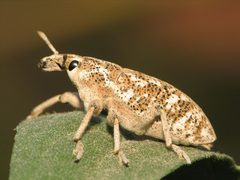
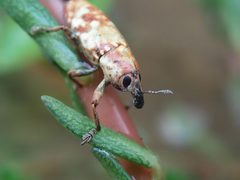
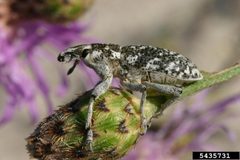
Distinguished from other knapweed-feeding weevils by its larger size (14–15 mm), flightless condition, and distinctive dark gray and white speckled coloration. Larval presence is indicated by conspicuous root galls on knapweed root crowns. The combination of large body size, flightlessness, and association with root galls on Centaurea separates it from smaller or weevil species in the same .
Images
Appearance
weevils are 14–15 mm long with a dark gray and white speckled coloration. The body is robust and typical of the Curculionidae, with an elongated snout. Adults are flightless.
Habitat
Associated with knapweed-infested grasslands, rangelands, and disturbed open . In its native range, occurs in southern Europe and the Mediterranean region. In North America, established in warmer and drier portions of the western United States where spotted and diffuse knapweed occur.
Distribution
Native to southern Europe and the Mediterranean region; introduced and established in the western United States (including Montana, Wyoming, Idaho, Washington, Oregon, Colorado, and neighboring states). First released in the United States in 1987. Recently reported from India.
Seasonality
emerge from mid-July to October. One per year.
Diet
Larvae feed on root cortex tissue of knapweeds, inducing gall formation. feed on knapweed foliage.
Host Associations
- Centaurea maculosa (spotted knapweed) - primary preferred ; successful larval development confirmed
- Centaurea diffusa (diffuse knapweed) - secondary successful larval development confirmed; less preferred than C. maculosa
- Centaurea friderici - successful larval development confirmed in laboratory studies
- Centaurea micranthos - successful larval development confirmed in laboratory studies
- Centaurea vallesiaca - successful larval development confirmed in laboratory studies
Life Cycle
One per year. Females deposit singly in notches excavated into the root crown of plants. Larvae emerge and tunnel into the root cortex, where feeding induces gall formation. Larvae overwinter in roots; in the native range, most overwinter as 2nd instars, while in the introduced North American range, the vast majority overwinter as 1st instars. emerge from mid-July to October and live 8–15 weeks. Females lay approximately 100 eggs during their adult lifespan.
Behavior
are flightless and move by . Females excavate notches in root crowns for oviposition. Larval feeding in root cortex induces formation of conspicuous galls. Feeding by older larvae can kill small plants or plants hosting multiple larvae.
Ecological Role
herbivore that reduces knapweed and rosette . Acts as a agent that can decrease seed production of knapweeds. In its native range, naturally regulates knapweed ; in North America, contributes to suppression of spotted and diffuse knapweed in warmer, drier portions of their invaded range.
Human Relevance
Used as a agent against spotted and diffuse knapweed in North America since 1987. Has not been shown to attack native flora; specificity testing confirmed narrow host range restricted to Centaurea subgenus Acrolophus. Evidence suggests contribution to observed declines in spotted knapweed in the 2000s, though drought may confound attribution.
Similar Taxa
- Other knapweed biological control agents (e.g., Larinus spp., Urophora spp.)These insects also attack knapweeds but differ in size, feeding site (seed vs. root), and gall . Cyphocleonus achates is distinguished by its larger size, root-feeding larvae, and flightless .
- Other Cyphocleonus or Cleonus speciesMay share general weevil but differ in associations, size, coloration, and geographic distribution. C. achates is specifically associated with knapweeds and has the distinctive speckled gray coloration.
More Details
Biocontrol establishment history
First approved for release in North America in 1987 based on specificity studies with 71 test plant . First shipments to the United States occurred in 1987. Released to Hiawatha National Forest, Michigan's Upper Peninsula, in summer 2009.
Overwintering plasticity
Exhibits geographic variation in stage: predominantly 2nd instars in native European range versus predominantly 1st instars in introduced North American range. The ecological significance of this difference has not been fully determined.
Sources and further reading
- BugGuide
- Wikipedia
- GBIF taxonomy match
- NCBI Taxonomy
- FIRST REPORT OF THE ESTABLISHMENT OF CYPHOCLEONUS ACHATES (FAHRAEUS) (COLEOPTERA: CURCULIONIDAE) ON SPOTTED KNAPWEED, CENTAURE A MACULOSA LAMARCK, IN THE UNITED STATES
- Investigations on Cyphocleonus achates (Fahr.) (Col., Curculionidae), a potential biological control agent of spotted knapweed (Centaurea maculosa Lam.) and diffuse knapweed (C. diffusa Lam.) (Compositae) in North America