
Cyphocleonus
Motschulsky, V. de, 1860
Species Guides
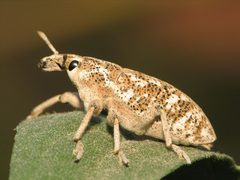
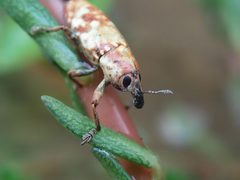
1- Cyphocleonus achates(knapweed root weevil)
Cyphocleonus is a of true weevils (Curculionidae) containing at least nine described . Several species have been investigated for of plants, with C. achates established in North America for knapweed management and C. trisulcatus evaluated for oxeye daisy control. The genus is native to Eurasia, with some species now introduced to North America.
Pronunciation
How to pronounce Cyphocleonus: //ˌsaɪfoʊˈkliːənəs//
These audio files are automatically generated. While they are not always 100% accurate, they are a good starting point.
Images
Distribution
Native to Europe and western Asia; introduced to North America for some . GBIF records indicate presence in Denmark, Norway, and Sweden.
Host Associations
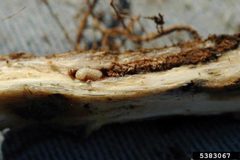
- Centaurea maculosa (spotted knapweed) - For C. achates; feed on foliage, larvae mine roots
- Centaurea diffusa (diffuse knapweed) - For C. achates
- Leucanthemum vulgare (oxeye daisy) - For C. trisulcatus
Ecological Role
Some function as agents for plants; C. achates has been established in North America to reduce knapweed .
Human Relevance
C. achates was approved for release in North America in 1987 and is considered an important agent for spotted and diffuse knapweed. C. trisulcatus was rejected for North American release due to attack on ornamental Shasta daisies.
More Details
Biological control species
At least two have been evaluated for : C. achates for knapweeds (Centaurea spp.) and C. trisulcatus for oxeye daisy. C. achates has a narrow range restricted to Centaurea subgenus Acrolophus.
Morphological note
C. achates are relatively large weevils (approximately 14 mm long) and are flightless.
Sources and further reading
- BugGuide
- Wikipedia
- GBIF taxonomy match
- iNaturalist taxon
- NCBI Taxonomy
- Catalogue of Life
- Evaluation of Cyphocleonus trisulcatus (Coleoptera: Curculionidae) as a potential biological control agent for Leucanthemum vulgare in North America
- FIRST REPORT OF THE ESTABLISHMENT OF CYPHOCLEONUS ACHATES (FAHRAEUS) (COLEOPTERA: CURCULIONIDAE) ON SPOTTED KNAPWEED, CENTAURE A MACULOSA LAMARCK, IN THE UNITED STATES
- Investigations on Cyphocleonus achates (Fahr.) (Col., Curculionidae), a potential biological control agent of spotted knapweed (Centaurea maculosa Lam.) and diffuse knapweed (C. diffusa Lam.) (Compositae) in North America