
Cleonis
Dejean, P.F.M.A., 1821
Species Guides
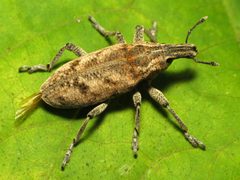
1Cleonis is a of cylindrical weevils (Curculionidae: Lixinae: Cleonini) comprising at least 120 described . Members are characterized by their elongated, cylindrical body form typical of the tribe Cleonini. The genus has a broad distribution across the Palaearctic region, with some species introduced to North America. Detailed biological information is available primarily for Cleonis pigra, which feeds exclusively on Asteraceae and develops within root galls.
Pronunciation
How to pronounce Cleonis: //kliˈoʊ.nɪs//
These audio files are automatically generated. While they are not always 100% accurate, they are a good starting point.
Identification
Cleonis are distinguished by their cylindrical body shape, a defining trait of the tribe Cleonini. Within Curculionidae, Cleonini can be separated from related tribes by larval and pupal characteristics: larvae possess a well-sclerotized capsule with distinct -bursters, and pupae have specific arrangements of setae on the pronotum and . Species-level identification requires examination of genitalia and rostral proportions.
Images
Habitat
occur in open, xeric with sandy soils, including alluvial floodplains, sheep pastures, and sandy chernozem areas with herbaceous vegetation. Specific documented habitats include alluvial floodplains near Kamyana Mohyla Reserve (Zaporizhia Province, Ukraine) and Pishchanska Balka near Melitopol (Ukraine).
Distribution
Palaearctic distribution spanning from the Iberian Peninsula to the Russian Far East, with northern limits at approximately 60°N in Scandinavia and 60–63°N in Sakha (Yakutiya), Russia. Common throughout Ukraine and central/southern Europe; rare in northern Europe. At least one (C. pigra) is in North America, established in the northeastern USA, southeastern Canada, and Atlantic region since 1919.
Diet
Based on documented study of C. pigra: and larvae feed exclusively on Asteraceae, specifically Carduus, Cirsium, Centaurea, and Onopordum. Diet for remaining in genus is not documented.
Host Associations
- Carduus - food plant and larvae
- Cirsium - food plant and larvae, including C. arvense
- Centaurea - food plant and larvae
- Onopordum - food plant and larvae
Life Cycle
For C. pigra: larvae develop endophagously inside galls formed on the root neck of plants. Oviposition occurs at the base of the stem or root neck. Number of larval instars estimated using Dyar's law. Laboratory rearing successful at 20°C, 70% relative humidity, and 12-hour . details for other Cleonis are not documented.
Behavior
and larvae are endophagous, feeding and developing within plant tissue. Adults of C. pigra have been observed to coexist with Cyphocleonus achates in the same localities. In open , adults become prey for animals.
Ecological Role
Some have been evaluated as potential biocontrol agents against thistles (e.g., Cirsium arvense), though C. pigra was rejected due to its wide range that includes cultivated globe artichoke. The serves as prey for animals in open .
Human Relevance
C. pigra has been investigated as a agent for thistles in North America but was rejected due to non-target feeding on globe artichoke. The is known as a pest of milk thistle (Silybum marianum).
Similar Taxa
- CyphocleonusBoth belong to tribe Cleonini and share cylindrical body form; can coexist in same localities. Distinguished by differences in rostral structure and larval/pupal .
- LixusRelated in Lixinae; both have elongated body forms. Lixus typically lack the pronounced cylindrical compression and have different plant associations.
More Details
Taxonomic history
established by Dejean in 1821. The tribe Cleonini has undergone repeated taxonomic revision, with Cleonis consistently recognized as a core member based on larval and .
Research limitations
Detailed biological data are available almost exclusively for C. pigra. The remaining ~119 described lack comparable documentation of , diet, , and . Generalizations to the level from this single species should be treated cautiously.