
Hyperinae
Cocoon Weevils
Genus Guides
3Hyperinae is a of true weevils (Curculionidae) whose larvae are notable for constructing silk cocoons for , earning them the 'Cocoon Weevils.' Larvae of some exhibit unusual social , including coordinated processionary movement and chemical trail-following—traits convergent with social caterpillars but rare among beetles. The subfamily's taxonomic placement has been debated, with some species historically classified under Molytinae. plant associations include Malvaceae and Ericaceae, with the latter representing a newly documented host for the group.
Pronunciation
How to pronounce Hyperinae: /ˌhaɪpəˈraɪniː/
These audio files are automatically generated. While they are not always 100% accurate, they are a good starting point.
Identification
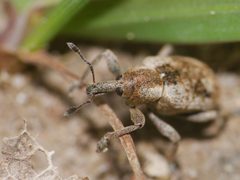
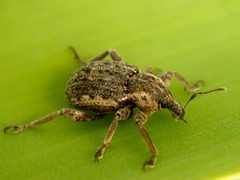
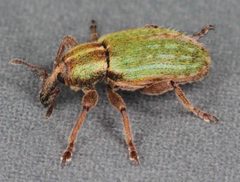
Larvae distinguished from other weevil by caterpillar-like (eruciform) body form, bright coloration, and presence of abdominal ambulatory ampullae. Mature larvae can be identified by their unique silk cocoon construction . resemble other true weevils and require examination of genitalia or other fine morphological characters for definitive subfamily assignment.
Images
Habitat
Larvae occur on leaves of plants in various environments including submontane mountain ranges, agricultural settings, and urban ornamental plantings. Specific documented include: leaves of Pachira aquatica trees in Brazilian cities; submontane Erica umbellata heath in northern Portugal; and celery crops in northwestern Mexico.
Distribution
Neotropical region (Central and South America), with documented occurrences in Brazil (Mato Grosso do Sul, Goiás, São Paulo), Mexico, and the Iberian Peninsula (northern Portugal).
Diet
Larvae feed on leaves of plants; documented hosts include Pachira aquatica (Malvaceae) and Erica umbellata (Ericaceae). feeding habits are not documented in available sources.
Host Associations
- Pachira aquatica - larval plantMalvaceae; ornamental tree in Brazilian cities
- Erica umbellata - larval plantEricaceae; first record of heather as for Hyperinae
- Apium graveolens - crop celery; agricultural pest association in Mexico
Life Cycle
Exophytic larval stage on plant leaves. Mature larvae spin globular lattice-like silk cocoons where occurs. Cocoon construction is a defining trait of the . Specific details on placement and longevity are not documented in available sources.
Behavior
Larvae of some exhibit coordinated social unique among beetles: single-file processionary movement with -to-tail contact, chemical trail-following using -produced active up to 4 hours, and cycloalexic (rosette-shaped) resting formations. Head-bobbing or vibration during movement may function in direct contact to excite group activity. and thigmotactic signals organize group cohesion; processions dynamically change leadership and can temporarily split and reunite.
Ecological Role
Herbivorous defoliator of plants. Larvae serve as prey for such as Supputius cinticeps (Hemiptera: Pentatomidae) and hosts for such as Jaliscoa nudipennis (Hymenoptera: Pteromalidae). Some are agricultural pests.
Human Relevance
Some are documented agricultural pests on celery crops. Others feed on ornamental trees (Pachira aquatica) in urban settings. The 's distinctive larval cocoons and social have scientific interest for studies of in social insects.
Similar Taxa
- MolytinaeHistorical taxonomic confusion—Hyperinae have sometimes been placed in Molytinae; differentiation requires morphological examination of and larval characters, particularly cocoon-spinning in Hyperinae larvae.
- Other Curculionidae subfamiliesLarvae of most other weevil lack the eruciform body, bright coloration, abdominal ampullae, and silk cocoon construction that characterize Hyperinae; most weevil larvae are endophytic or soil-dwelling rather than free-living leaf feeders.
More Details
Taxonomic Status
The placement of Hyperinae has been debated, with some classifications merging it into Molytinae. Recent treatments maintain it as distinct.
Convergent Evolution
The social processionary of Phelypera distigma represents remarkable convergence with social caterpillars (Lepidoptera) and (Hymenoptera: ), including chemical trail-marking—a trait previously unknown in beetles.
Research Limitations
Most detailed behavioral and information comes from a few well-studied (Phelypera distigma, P. schuppeli, Donus proximus); broader generalizations about the remain tentative.
Sources and further reading
- BugGuide
- Wikipedia
- iNaturalist taxon
- NCBI Taxonomy
- Zu Biologie und Identität von Donus proximus (Capiomont, 1876) comb. nov. (Coleoptera, Curculionidae, Hyperinae)
- Description of immature stages of Phelypera schuppeli (Boheman, 1834) with comments on natural history (Coleoptera: Curculionidae: Hyperinae)
- Social Behavior of Larvae of the Neotropical Processionary Weevil Phelypera distigma (Boheman) (Coleoptera: Curculionidae: Hyperinae)
- Spatial Distribution of Listroderes costirostris and Hypera postica (Curculionidae: Cyclominae, Hyperinae) on a Celery Crop in Mexico's Northwest Region